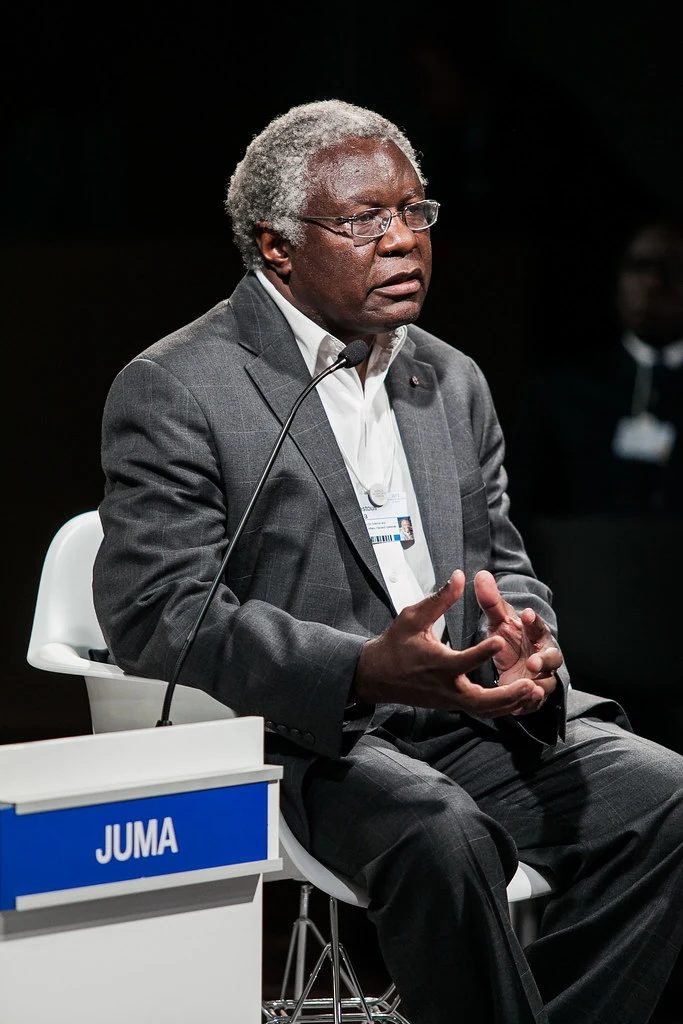
World Economic Forum / Jakob Polacsek / CC BY-NC-SA 2.0. Resized for the archive. Image credits.
Calestous Juma
Scholar of innovation and development
He asked how science could change the possibilities open to Africa.
- Theme
- Science & Innovation
Calestous Juma studied the relationship between technological innovation, public policy and development. His work connected scientific change with practical questions about agriculture, industry and the institutions needed to support them.
Through teaching and writing, including at Harvard, he argued for a stronger place for African countries in the creation and use of technology. His contribution was to make innovation a question of public purpose as well as invention.
Life and work
Calestous Juma (9 June 1953 – 15 December 2017) was a Kenyan scientist and academic, specializing in sustainable development. He was named one of the most influential 100 Africans in 2012, 2013 and 2014 by the New African magazine. He was Professor of the Practice of International Development and Faculty Chair of the Innovation for Economic Development Executive Program at Harvard Kennedy School. Juma was Director of the School's Science, Technology and Globalization Project at Harvard Kennedy School as well as the Agricultural Innovation in Africa Project funded by the Bill and Melinda Gates Foundation.
For his work in the application of science, technology and innovation to policy and sustainable development, BMGF in 2021 launched a fellowship in his honour, the Calestous Juma Science Leadership Fellowship to fund exemplary African scientific leaders. ''For this Fellowship, "leadership" is demonstrated by scientists who have the expertise to do transformative science on the ground and the experience, networks, and skills to anchor health and development R&D in their communities, design or co-design projects with local and global partners, and mobilize key institutions in their countries. His last book, Innovation and Its Enemies: Why People Resist New Technologies, was published by Oxford University Press in 2016.
Juma was elected to the Royal Society of London, the US National Academy of Sciences, Third World Academy of Sciences (TWAS), the UK Royal Academy of Engineering, the African Academy of Sciences and the New York Academy of Sciences.
Juma grew up on the Kenyan shores of Lake Victoria, where he obtained early education as one of the pioneer students of the Port Victoria Secondary School (now John Osogo SS) from 1968 to 1971. He first worked as an elementary school teacher before becoming Africa's first science and environment journalist at Kenya's Daily Nation newspaper. Juma later joined the Nairobi-based Environment Liaison Centre International as a founder and editor of trilingual quarterly magazine, Ecoforum. He later received an MSc in Science, Technology and Industrialization and a DPhil in Science and Technology Policy from the Science Policy Research Unit at the University of Sussex.
In 1988, Juma founded the African Centre for Technology Studies, Africa's first independent policy research institution designed to advance research on technology in development. In 1989 ACTS released a groundbreaking study called "Innovation and Sovereignty" that led to the adoption of the Industrial Property Act in Kenya and the creation of the Kenya Industrial Property Office.
His original work focused on analysing the dynamics of evolutionary technological change and applying the results in advancing science and technology policy research, providing high-level science and technology advice, and promoting biodiversity conservation.
Juma made significant contributions to understanding the dynamic role of technological innovation in economic transformation in developing countries. He developed the concept of "evolutionary technological change" to explain how socio-economic environments shape the adoption and diffusion of new technologies. This approach was elaborated in his early works such as Long-Run Economics: An Evolutionary Approach to Economic Growth (Pinter, 1987) and The Gene Hunters: Biotechnology and the Scramble for Seeds (Princeton University Press and Zed Books, 1989) and remains central to theoretical and practical work. Juma's contributions to science and technology policy focused on the role of technological innovation in sustainable development.
He directed the International Diffusion of Biotechnology Programme of the International Federation of Institutes of Advanced Studies. He further provided international leadership in research, training and outreach through Harvard University's Kennedy School of Government and also advanced scholarship in this field as editor of the peer-reviewed International Journal of Technology and Globalisation.
Juma contributed to biodiversity conservation in two ways. First, he helped to shape global conservation programmes during his tenure as the first permanent Executive Secretary of the Convention on Biological Diversity in Geneva and Montreal. Second, his research inspired the field of biodiplomacy that focuses on interactions between biosciences and international relations.
This section adapts selected passages from Calestous Juma by Wikipedia contributors. It is shared under CC BY-SA 4.0. Selected passages; pronunciation guides, lists and reference markers omitted; punctuation and paragraph breaks adjusted. Photographs have separate licences.