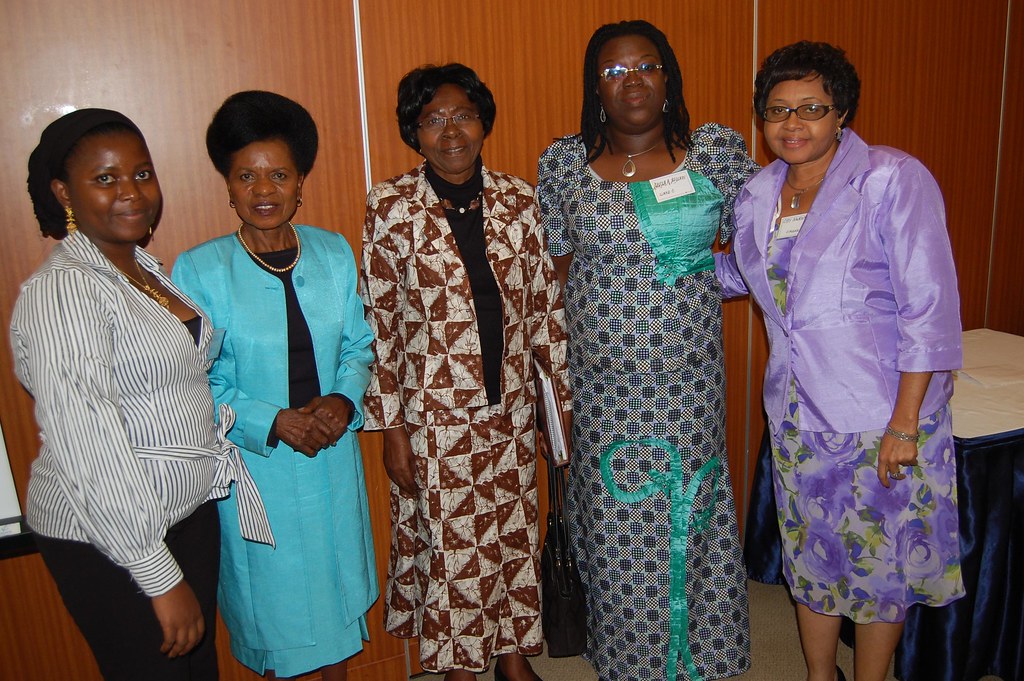
Julia Ojiambo at a regional forum on women’s political leadership, Nairobi, September 2011. Full group photograph.
Heinrich Böll Stiftung Nairobi; Kenya l Uganda l Tanzania / CC BY-NC-ND 2.0. Published file, unaltered. Image credits.
Julia Ojiambo
Nutrition researcher and public servant
She brought scientific training into education and public life.
- Theme
- Public Life
Julia Auma Ojiambo built a public career across nutrition, education, research and politics. Her achievement was not simply to enter institutions that had admitted few African women. She used those positions to work on the conditions of daily life: what children ate, how women participated in decisions, and how knowledge could become a public service. Her biography connects the expansion of higher education in Kenya with the struggle for a wider understanding of leadership.
Born in 1936 in what is now Busia County, she attended the African Girls' High School, later known as Alliance Girls, as one of its early pupils. In 1956 she entered the Royal Technical College, the institution that developed into the University of Nairobi. Her training in home economics led towards a career in nutrition, a field in which the household, the clinic and public policy meet.
Her studies took her to London and later to the Harvard School of Public Health. She also pursued research at McGill before completing her doctorate at the University of Nairobi. The university identifies her as the first doctoral graduate in its Department of Community Health. These milestones belong within the history of a new national university building its own capacity for advanced research and training. They also show the determination required of women pursuing professional education through institutions whose expectations had been formed largely around men.
Ojiambo's nutritional work addressed practical problems. The Kenya Yearbook account describes her involvement in research on childhood malnutrition and anaemia, and in the introduction of nutrition teaching at university level. Her career makes clear that food is a public-health question as well as a matter of agricultural production. A country can grow food while children remain poorly nourished; research and teaching are part of understanding and addressing that gap.
She moved into parliamentary politics in the 1970s, winning the Busia Central seat in 1974. She subsequently represented Funyula and served as an assistant minister. Her election was part of the small but consequential early presence of women in Kenya's post-independence Parliament. The difficulty was not limited to gaining a seat. It included making issues affecting women and families part of an institution's ordinary business, rather than allowing them to remain an occasional supplement to it.
Ojiambo's involvement in women's organisations connected this national career with networks beyond Parliament. Research on East Africa's global connections records her participation in the international women's conferences associated with the United Nations, including the Nairobi conference of 1985 and the Beijing conference of 1995. Such gatherings provided places to compare experiences and bring demands for representation into a wider political conversation. The benefits depended on the work of translating that conversation back into local institutions and organising.
Her academic and political careers should therefore be read together. Nutrition research gave substance to arguments about health and economic security. Teaching helped create a professional community able to carry that work forward. Parliamentary service offered a different route for influencing public decisions. Women's organising challenged the restrictions that determined who could take part in any of those activities.
Ojiambo's contribution to Kenya is best understood through these connections. A list of firsts establishes the barriers she crossed, but it does not exhaust the meaning of the work. Her life also asks what becomes possible when a scientist enters political debate, when women's experience is treated as knowledge, and when education opens into service beyond the university.
Add to this story