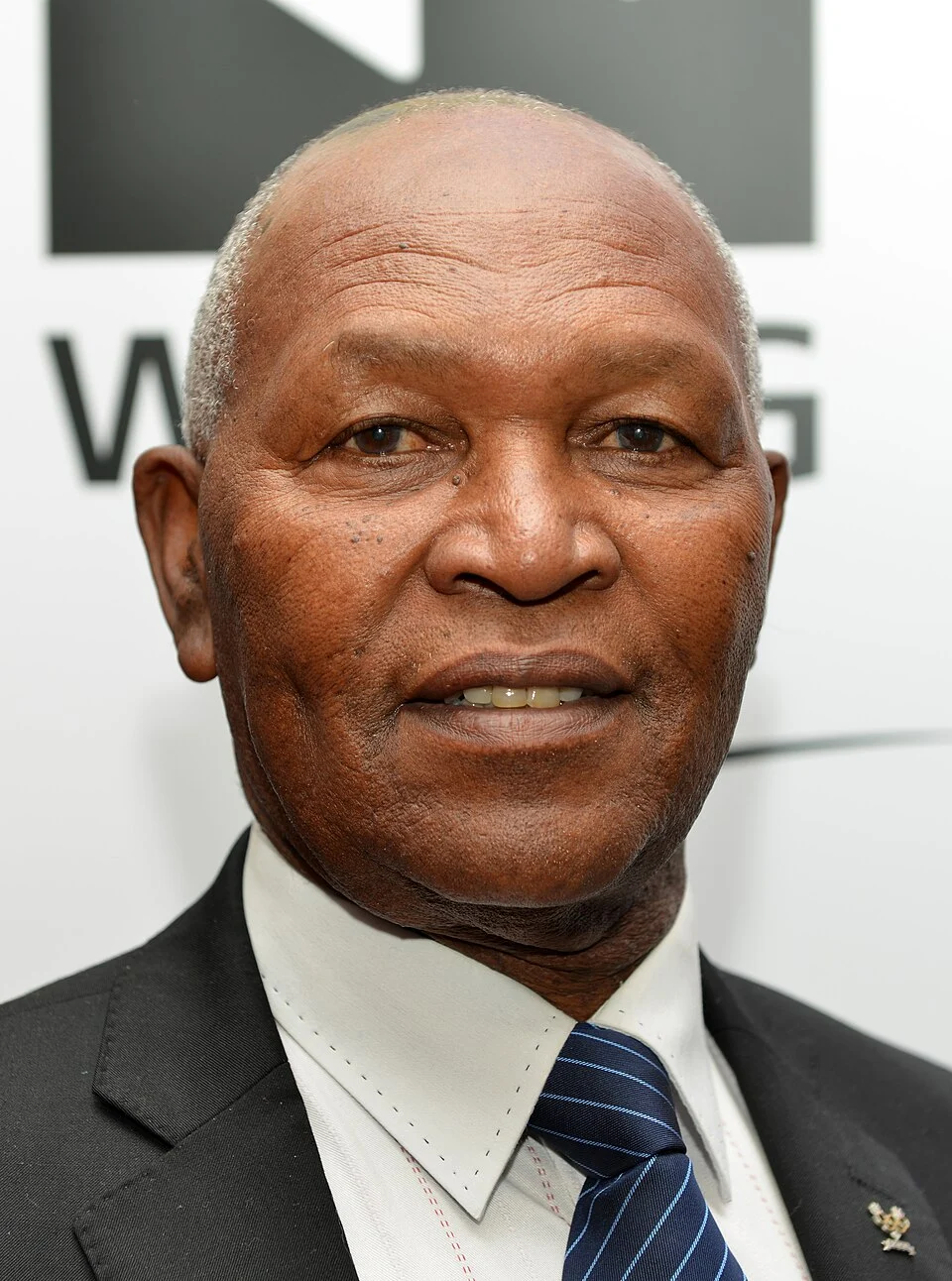
Ralf Roletschek / CC BY 3.0. Resized for the archive. Image credits.
Kipchoge Keino
Olympic pioneer · Philanthropist
b. 1940
The runner who showed the world what Kenya could do.
- Theme
- Champions
- Also known as
- Hezekiah Kipchoge ‘Kip’ Keino
Before there was a Kenyan running dynasty, there was Kip Keino. Racing at altitude-defying speed; once sprinting to the stadium through Mexico City traffic to make his start; he won Olympic gold in 1968 and again in 1972, announcing East Africa’s arrival at the summit of world athletics. In retirement he and his wife turned their farm into a home for hundreds of orphaned children. He opened a door that thousands of Kenyan runners have since run through, and spent his fame raising those who had nothing.
His Olympic victories came in different events: the 1,500 metres at Mexico City in 1968 and the 3,000 metres steeplechase at Munich in 1972. He also won silver in the 5,000 metres in 1968 and the 1,500 metres in 1972.
Life and work
Kipchoge Hezekiah Keino (born 17 January 1940) is a retired Kenyan track and field athlete. He was the chairman of the Kenyan Olympic Committee (KOC) until 29 September 2017. A two-time Olympic gold medalist, Keino was among the first in a long line of successful middle and long distance runners to come from the country and has helped and inspired many of his countrymen and women to become the athletics force that they are today. In 2000, he became an honorary member of the International Olympic Committee (IOC). In 2012, he was one of 24 athletes inducted as inaugural members of the IAAF Hall of Fame.
Keino was born on 17 January 1940 in Kipsamo, Nandi District, Kenya. His name, Kipchoge, is a Nandi language expression for "born near the grain storage shed." His parents died when he was a youngster and he was raised by an aunt. After finishing school, he joined the Kenya Police. Before taking up athletics, he played rugby.
He began his international career at the 1962 Commonwealth Games in Perth, Western Australia where he came eleventh in the three miles. At the 1964 Summer Olympics he finished fifth in 5000 m and just missed qualification for the 1500 m final.
On 27 August 1965, Keino lowered the 3000 m world record by over 6 seconds to 7:39.6 in his first attempt at the distance. He won two gold medals (1500 and 5000 metres) at the inaugural All-Africa Games. Later in that year, he broke the 5000 m world record held by Ron Clarke, clocking 13:24.2. At the 1966 Commonwealth Games in Kingston, Jamaica, he won both the mile run and three-mile run. In the next Commonwealth Games, Keino won the 1500 metres and was third in the 5000 metres.
At the 1968 Summer Olympics in Mexico City, he won the 1500 metres gold medal (defeating American favourite and world record holder Jim Ryun by 20 metres, the largest winning margin in the history of the event) and 5000 m silver medal. Four years later, he won the 3000 metres steeplechase gold and 1500 metres silver at the 1972 Summer Olympics in Munich, Germany. Keino was the flag bearer for Kenya in the 1964 Summer Olympics and the 1972 Summer Olympics opening ceremonies. Keino retired in 1973. He is on the cover of the October 1968 issue of Track and Field News, the first issue following the Olympics. He shared the cover of the September 1969 issue with Naftali Bon.
With his wife, Phyllis Keino, he has dedicated significant efforts to humanitarian work in Eldoret, Kenya. They have established the Lewa Children's Home for orphans, the KipKeino Primary School in 1999, and the Kip Keino Secondary School in 2009.
For his work with orphans, he shared Sports Illustrated magazine's "Sportsmen and Sportswomen of the Year" award in 1987 with seven others, characterized as "Athletes Who Care". In 1996, Kipchoge Keino Stadium in Eldoret was named after him.
In 2007, he was made an honorary Doctor of Law by the University of Bristol. Earlier, Egerton University in Nakuru had awarded him an honorary degree. In July 2012, he received further recognition from the City of Bristol after the Kenyan Olympic Committee, under his presidency, made Bristol the training base for its athletes in preparation for the London 2012 Olympics. In 2012, Kipchoge Keino was among the inductees in the IAAF Hall of Fame. The Bristol City Council awarded him freedom of the city, making him the first to receive this honour from Bristol since Sir Winston Churchill.
On 5 August 2016, at the Olympic opening ceremony in Rio de Janeiro, Brazil, Keino was awarded the first Olympic Laurel, for outstanding service to the Olympic movement.
This section adapts selected passages from Kipchoge Keino by Wikipedia contributors. It is shared under CC BY-SA 4.0. Selected passages; pronunciation guides, lists and reference markers omitted; punctuation and paragraph breaks adjusted. Photographs have separate licences.
He won medals, then spent a lifetime raising children who weren’t his own.
Add to this story