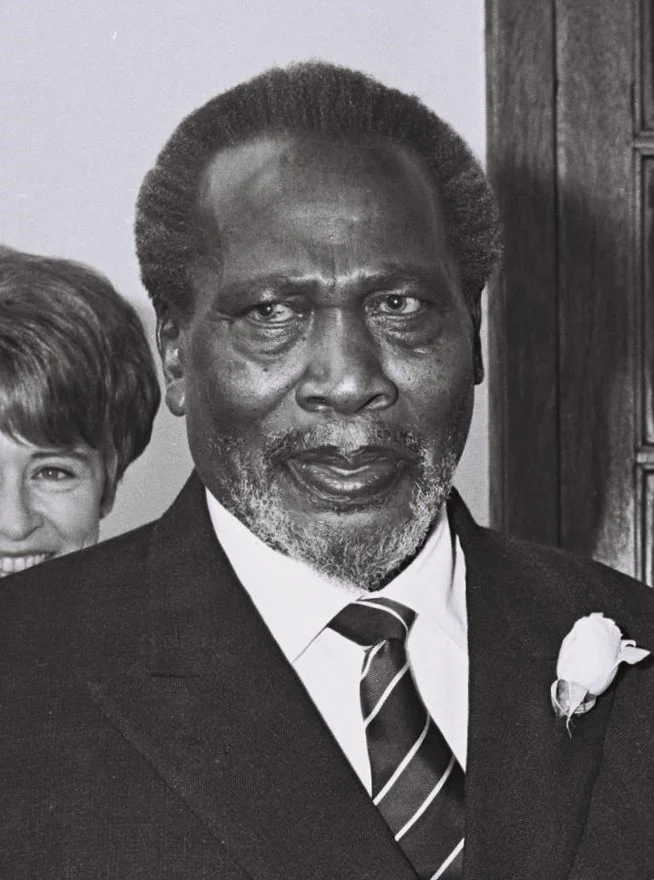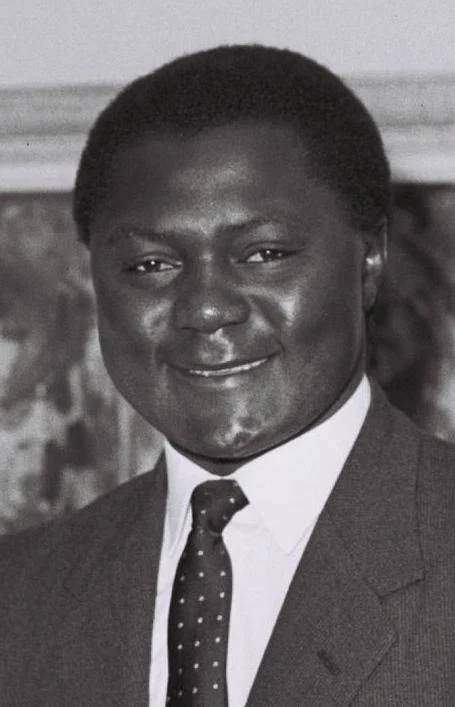
Israeli GPO photographer / Public domain. Resized for the archive. Image credits.
Tom Mboya
Trade unionist · Statesman
1930 – 1969
He opened a door across the ocean for a generation of Kenyans.
- Theme
- Founders
- Also known as
- Thomas Joseph Mboya
Tom Mboya rose from trade-union halls to become one of the most brilliant architects of independent Kenya; a negotiator at the constitutional talks and a tireless builder of institutions. His famous ‘airlift’ flew hundreds of young East Africans to study in American universities, seeding a whole generation of the nation’s teachers, leaders and professionals. He was assassinated in a Nairobi street in 1969, at just thirty-eight. The country has spent the decades since wondering what he might have built with more time.
Life and work
Thomas Joseph Odhiambo Mboya (15 August 1930 – 5 July 1969) was a Kenyan politician and labour leader. He was one of the founding fathers of the Republic of Kenya. He led the negotiations for independence at the Lancaster House Conferences and was instrumental in the formation of Kenya's independence party – the Kenya African National Union (KANU) – where he served as its first Secretary-General. He laid the foundation for Kenya's capitalist and mixed economy policies at the height of the Cold War and set up several of the country's key labour institutions. Mboya was Minister for Economic Planning and Development when he was assassinated.
Mboya's intelligence, charm, leadership, and oratory skills won him admiration from all over the world. He gave speeches, participated in debates and interviews across the world in favour of Kenya's independence from British colonial rule. He also spoke at several rallies in the goodwill of the Civil Rights movement in the United States. In 1958, at the age of 28, Mboya was elected Conference Chairman at the All-African Peoples' Conference convened by Kwame Nkrumah of Ghana. He helped build the Trade Union Movement in Kenya, Uganda and Tanzania, as well as across Africa. He also served as the Africa Representative to the International Confederation of Free Trade Unions (ICFTU). In 1959, Mboya called a conference in Lagos, Nigeria, to form the first All-Africa ICFTU labour organization.
Mboya worked with both John F. Kennedy and Martin Luther King Jr. to create educational opportunities for African students, an effort that resulted in the Kennedy Airlifts of the 1960s enabling East African students to study in American colleges. Notable beneficiaries of this airlift include Wangari Maathai. In 1960, Mboya was the first Kenyan to be featured on the front page cover of Time magazine in a painting by Bernard Safran.
His parents Leonardus Ndiege and Marcella Onyango were from the Luo ethnic group of Kenya, and were both low-income sisal cutters working on the colonial farm of Sir William Northrup McMillan, at today's Juja Farm Area. Thomas ("Tom") Joseph Odhiambo Mboya was born at this colonial sisal farm on 15 August 1930, near the town of Thika, in what was called the White Highlands of Kenya.
Mboya's father Leonard Ndiege was later promoted as an overseer at this sisal plantation and worked for 25 years. Eventually Leonard and Marcella had seven children, five sons and two daughters. When Mboya was nine years old, his father sent him to a mission school in Kamba region.
Mboya was educated at various Catholic mission schools. In 1942, he joined St. Mary's School Yala – a Catholic secondary school in Yala, located in Nyanza province where Mboya began his education in English and History. In 1946, he attended the Holy Ghost College (later Mang'u High School), where he passed well enough to proceed to do his Cambridge School Certificate. In 1948, Mboya joined the Royal Sanitary Institute's Medical Training School for Sanitary Inspectors at Nairobi, qualifying as an inspector in 1950. He also enrolled in a certificate course in economics at Efficiency Correspondence College of South Africa. In 1955, he received a scholarship from the Trades Union Congress to attend Ruskin College, where he studied industrial management. After his graduation in 1956, he returned to Kenya and joined politics at a time when the British colonial authorities were gradually suppressing the Mau Mau rebellion spearheaded by the Kenya Land and Freedom Army.
Mboya's political life started immediately after he was employed at Nairobi City Council as a sanitary inspector in 1950. During his stint at Nairobi City Council, Mboya was elected as African Staff Association's president and immediately embarked on moulding the association into a trade union named the Kenya Local Government Workers' Union. This made his employer suspicious, but he resigned from his position before he could be laid off. He was, however, able to continue working for the Kenya Labour Workers Union as secretary-general before embarking on his studies in Britain.
This section adapts selected passages from Tom Mboya by Wikipedia contributors. It is shared under CC BY-SA 4.0. Selected passages; pronunciation guides, lists and reference markers omitted; punctuation and paragraph breaks adjusted. Photographs have separate licences.
Educate one young person and you change a nation’s arithmetic.
Add to this story