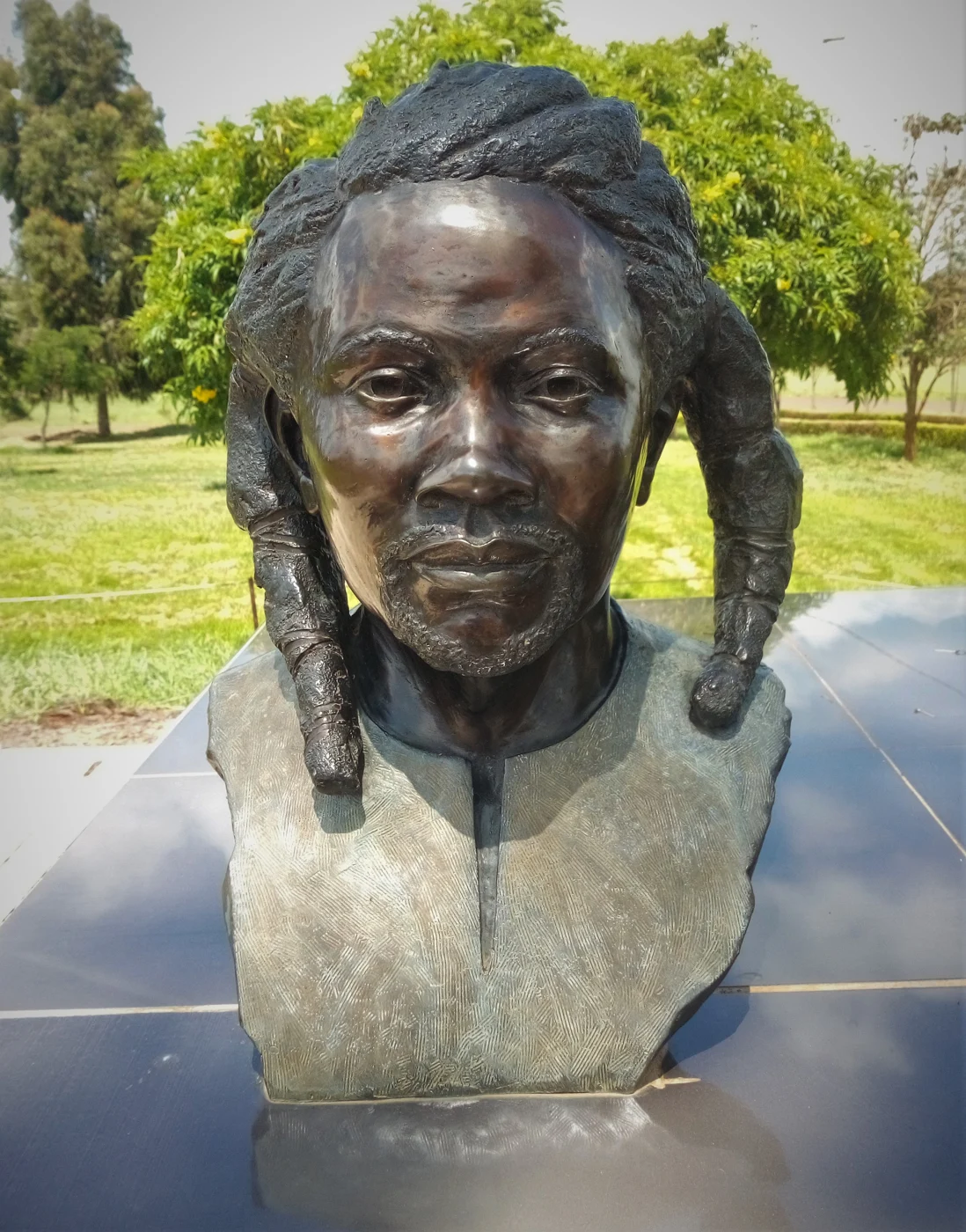
Elijah Masinde
Anti-colonial organiser and religious leader
He made resistance part of a movement rooted in local belief.
- Theme
- Liberation
Elijah Masinde founded Dini ya Musambwa, a religious movement associated with resistance to colonial authority in western Kenya. The movement challenged both the political and cultural dominance of colonial institutions.
He faced repeated repression and detention. His place in the archive rests on documented organising and resistance; religious belief is part of the historical setting, not evidence for supernatural claims.
Life and work
Born around 1910 – 1912 in Kimilili, Bungoma District, Masinde wa Nameme okhwa Mwasame was initiated into the Machego age-set. At the time, the Kenya-Uganda railway was passing through Ababukusu land. He began to practice football at a young age, eventually starting out as a footballer and captaining a football team from Kimilili. He also played for the Kenyan national team in the Gossage Cup against Uganda in 1930.
By the early 1940s, he had risen to the rank of a junior elder within his community in Kimilili area, and become increasingly anti-colonial. In 1944, he led a number of localised defiance campaigns against the colonial authorities, and was imprisoned many times as a result. At one time he was put in Mathare Mental Hospital, and on another occasion he was detained in Lamu.
Upon Kenya's independence, Masinde was detained by the government of Jomo Kenyatta for almost 15 years. He was accused of fomenting religious hatred. He was released by the government of Daniel arap Moi in 1978, however, Moi also arrested him following his clashes with traffic policemen in Webuye and Kitale. Elija Masinde remained defiant and continually questioned post independence Kenya's government, especially on the issue of land distribution and citizen rights. He died in 1987, considered a neglected freedom fighter.
Before his death, Masinde said that one of his relatives had bewitched him. He also described to his elder son where he wanted to be buried: he wanted a huge sycamore tree uprooted to make way for his grave. The family decided to bury him elsewhere, though, but the spot they chose for his grave turned out to be someone else's hidden grave. They took this to be an omen and proceeded to bury him in the spot where the sycamore tree had been.
Dini ya Musambwa belongs within a history in which religious organisation and political authority were closely connected. A movement could challenge colonial institutions not only by making political demands, but by questioning the cultural claims through which those institutions justified their power. Masinde's leadership brought those forms of resistance together.
This does not require the archive to affirm every belief associated with the movement. Beliefs are part of the historical record because they informed people's actions and relationships. The documented organising, repression and continued public significance establish Masinde as a real historical actor. Keeping that distinction clear allows readers to understand a form of anti-colonial resistance whose vocabulary differed from that of parties, unions or the forest armies, without turning religious tradition into an unsupported account of supernatural events.
His life also broadens the geography of liberation, placing western Kenyan organising within the national history of resistance and political change.
This section adapts selected passages from Elijah Masinde by Wikipedia contributors. It is shared under CC BY-SA 4.0. Selected and edited passages, with additional editorial context; lists and reference markers omitted; punctuation and paragraph breaks adjusted. Photographs have separate licences.
More from Liberation
Dedan Kimathi
Field Marshal of the Mau Mau
c. 1920 – 1957 · Memorial bust
Mekatilili wa Menza
Leader of the Giriama resistance
fl. 1910s
A woman who raised a people against the empire with a dance and an oath.
Muthoni Kirima
Mau Mau Field Marshal
1930 – 2023
A woman who became a field marshal in the struggle for independence.