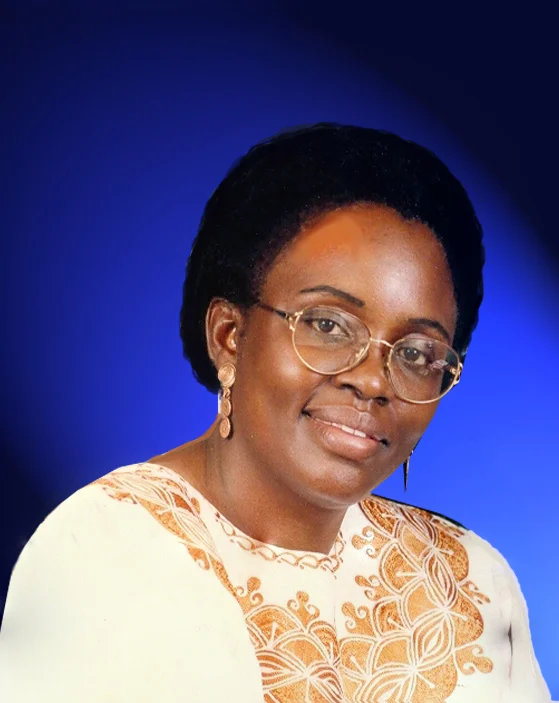
Grace Ogot
Novelist and short-story writer
She carried the textures of Luo life into Kenyan fiction.
- Theme
- Arts & Letters
Grace Ogot was among the pioneering women of modern Kenyan literature. Her fiction, including The Promised Land and the stories in Land Without Thunder, explored community, migration and changing social expectations.
She wrote in English and Dholuo, drawing on oral traditions without treating them as relics. Her work helped establish a place for women's authorship and for local histories within a national literature.
Life and work
Grace Emily Ogot (née Akinyi; 15 May 1930 – 18 March 2015) was a Kenyan author, nurse, journalist, politician and diplomat. Together with Charity Waciuma she was the first Anglophone female Kenyan writer to be published. She was one of the first Kenyan members of parliament and she became an assistant minister.
Ogot was born Grace Emily Akinyi to a Christian family on 15 May 1930 in Asembo, in the district of Nyanza, Kenya – a village highly populated by the predominantly Christian Luo ethnic group. Her father, Joseph Nyanduga, was one of the first men in the village of Asembo to obtain a Western education. He converted early on to the Anglican Church, and taught at the Church Missionary Society’s Ng'iya Girls’ School. From her father, she learned the stories of the Old Testament and it was from her grandmother that Ogot learned the traditional folk tales of the area from which she would later draw inspiration.
Grace Ogot's background was very interesting. Ogot attended the Ng'iya Girls' School and Butere High School throughout her youth. From 1949 to 1953, she trained as a nurse at the Nursing Training Hospital in Uganda. She later worked in London, England, at St. Thomas Hospital for Mothers and Babies. She returned to the African nursing English.
In addition to her experience in healthcare, Ogot gained experience in multiple different areas, working for the BBC Overseas Service as a script-writer and announcer on the programme London Calling East and Central Africa, operating a prominent radio programme in the Luo language, working as an officer of community development in Kisumu County and as a public relations officer for the Air India Corporation of East Africa.
In 1975, Ogot worked as a Kenyan delegate to the general assembly of the United Nations. Subsequently, in 1976, she became a member of the Kenyan delegation to UNESCO. That year, she chaired and helped found the Writers' Association of Kenya. In 1983, she became one of only a handful of women to serve as a member of parliament and the only woman assistant minister in the cabinet of then President Daniel arap Moi.
In 1968, Grace Ogot read her short story "A Year of Sacrifice" at a conference on African Literature at Makerere University in Uganda. After discovering that there was no other work presented or displayed from East African writers, Ogot became motivated to publish her works, which she subsequently did both in the Luo language and in English. "A Year of Sacrifice" appeared in print as Ogot's first published work in the African journal Black Orpheus in 1963. In 1964, her short story "The Rain Came" was published as part of the collection Modern African Stories, co-edited by Es'kia Mphahlele, who had organised the earlier mentioned conference on African Literature at Makerere University in Uganda in 1962. "The Rain Came" was a reworked version of "A Year of Sacrifice" but considerably shortened and with a different beginning and ending. Also in 1964, the short story "Ward Nine" was published in the journal Transition.
Ogot's first novel The Promised Land, set in the 1930s, was published in 1966 and focused on Luo emigration and the problems that arise through migration. Her main protagonists emigrate from Nyanza to northern Tanzania, in search of fertile land and wealth. The story also focused on themes of tribal hatred, materialism, and traditional notions of femininity and wifely duties. 1968 saw the publishing of Land Without Thunder, a collection of short stories set in ancient Luoland. Ogot's descriptions, literary tools, and storylines in Land Without Thunder offer a valuable insight into Luo culture in pre-colonial East Africa. Her other works include The Strange Bride , The Graduate, The Other Woman and The Island of Tears.
This section adapts selected passages from Grace Ogot by Wikipedia contributors. It is shared under CC BY-SA 4.0. Selected passages; pronunciation guides, lists and reference markers omitted; punctuation and paragraph breaks adjusted. Photographs have separate licences.