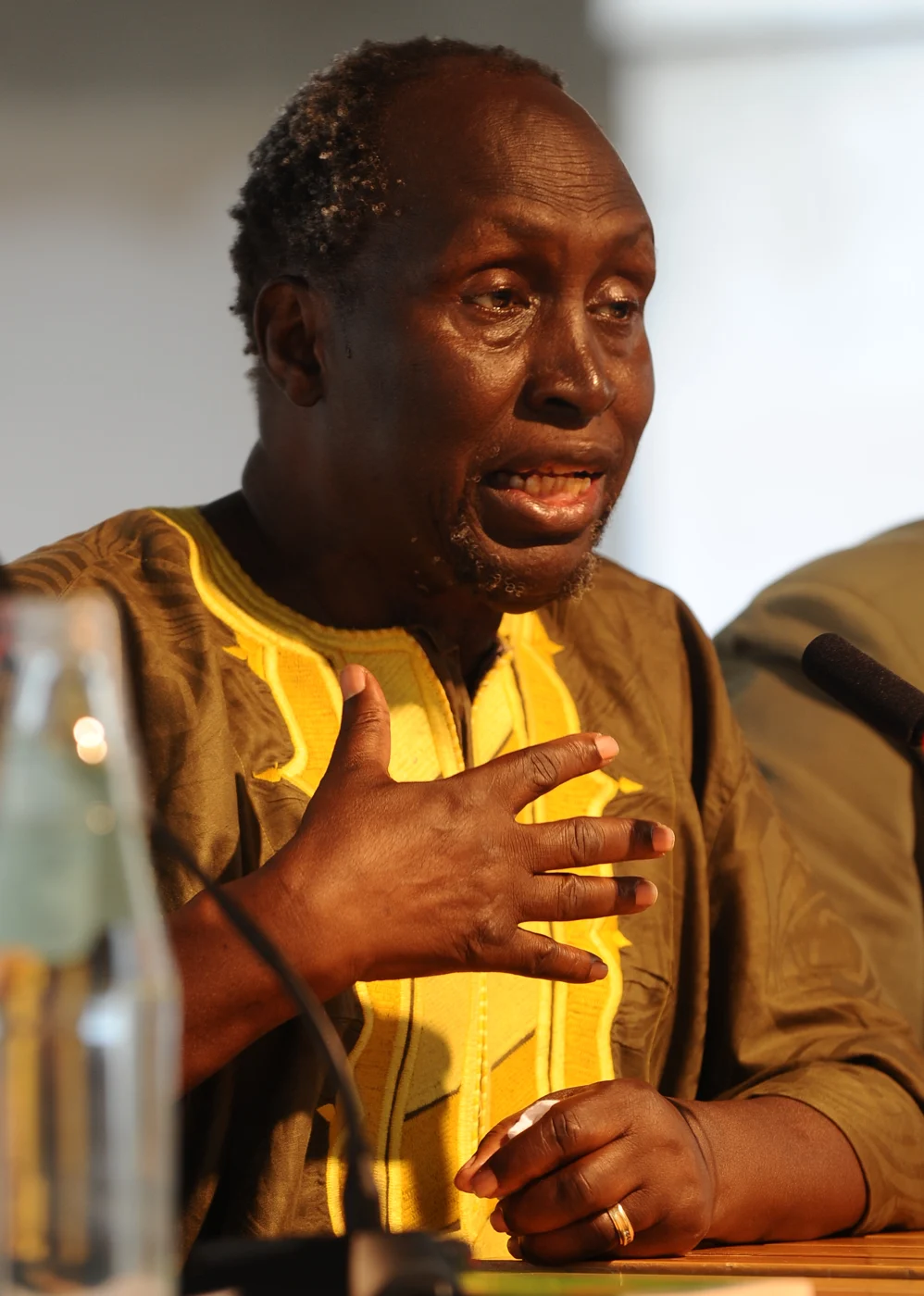
Niccolò Caranti / CC BY-SA 3.0. Resized for the archive. Image credits.
Ngũgĩ wa Thiong’o
Novelist · Decolonial thinker
1938 – 2025
He gave the African novel back its own languages.
- Theme
- Arts & Letters
Ngũgĩ wa Thiong’o began writing in English and became one of the world’s great novelists; then made the radical decision to write in his mother tongue, Gĩkũyũ, arguing that a people colonised in their language are colonised in their minds. For a play staged in his home village he was imprisoned without trial, and wrote his next novel on prison toilet paper. Exiled for years, he never stopped insisting that African stories belong to Africans, in African tongues. He died in 2025, mourned as a giant of world literature and a liberator of the imagination.
His books include Weep Not, Child, A Grain of Wheat, Devil on the Cross and Wizard of the Crow. His memoirs revisit colonial childhood, school and Makerere University. In Wrestling with the Devil, he returned to the imprisonment during which he wrote the Gĩkũyũ novel later translated as Devil on the Cross.
Life and work
Ngũgĩ wa Thiong'o (Gikuyu:; born James Ngugi; 5 January 1938 – 28 May 2025) was a Kenyan author and academic, who has been described as East Africa's leading novelist and an important figure in modern African literature.
Ngũgĩ wrote primarily in English before switching to writing primarily in Gikuyu and becoming a strong advocate for literature written in native African languages. His works include novels such as the celebrated novel The River Between, plays, short stories, memoirs, children's literature and essays ranging from literary to social criticism. He was the founder and editor of the Gikuyu-language journal Mũtĩiri. His 2016 short story "The Upright Revolution: Or Why Humans Walk Upright" has been translated into more than 100 languages.
Ngũgĩ was subsequently imprisoned for more than a year. Adopted as an Amnesty International prisoner of conscience, he was released from prison and fled Kenya. He was appointed Distinguished Professor of Comparative Literature and English at the University of California, Irvine. He had previously taught at University of Nairobi, Northwestern University, Yale University, and New York University. Ngũgĩ was frequently regarded as a likely candidate for the Nobel Prize in Literature. He won the 2001 International Nonino Prize in Italy, and the 2016 Park Kyong-ni Prize. Among his children are authors Mũkoma wa Ngũgĩ and Wanjikũ wa Ngũgĩ.
Ngũgĩ was born on 5 January 1938 in Kamiriithu, near Limuru in Kiambu district, Kenya Colony of the British Empire. He is of Kikuyu descent, and was baptised James Ngugi. His father, Thiong'o wa Ndūcũ, had four wives and 28 children; Ngũgĩ was born to his third wife, Wanjiku wa Ngũgĩ. His family were farmers whose land had been repossessed under the British Imperial Land Act of 1915. During Ngũgĩ's childhood, they were caught up in the 1952–1960 Mau Mau Uprising; his half-brother Mwangi was actively involved in the Kenya Land and Freedom Army (in which he was killed), another brother was shot during the State of Emergency, and his mother was tortured at the Kamiriithu home guard post.
Ngũgĩ's debut novel, Weep Not, Child, was published in May 1964. It was the first novel in English to be published by an African writer from East Africa.
Ngũgĩ's 1967 novel A Grain of Wheat marked his embrace of Fanonist Marxism. He subsequently renounced writing in English, and the name James Ngugi as colonialist; by 1970 he had changed his name to Ngũgĩ wa Thiong'o, and began to write in his native Gikuyu. In 1967, Ngũgĩ also began teaching at the University of Nairobi as a professor of English literature. He continued to teach at the university for ten years while serving as a Fellow in Creative Writing at Makerere University. During this time, he also guest-lectured at Northwestern University in the department of English and African Studies for a year.
While a professor at the University of Nairobi, Ngũgĩ was the catalyst of the discussion to abolish the English department. He argued that after the end of colonialism, it was imperative that a university in Africa teach African literature, including oral literature, and that such should be done with the realization of the richness of African languages. In the late 1960s, these efforts resulted in the university dropping English Literature as a course of study, and replacing it with one that positioned African Literature, oral and written, at the centre.
In 1976, Ngũgĩ helped to establish The Kamiriithu Community Education and Cultural Centre which, among other things, organised African Theatre in the area. The following year saw the publication of Petals of Blood. Its strong political message, and that of his play Ngaahika Ndeenda (I Will Marry When I Want), co-written with Ngũgĩ wa Mirii and also published in 1977, provoked the then Kenyan Vice-President Daniel arap Moi to order his arrest. Copies of his play, books by Karl Marx, Friedrich Engels, and Vladimir Lenin were confiscated from him. He was sent to Kamiti Maximum Security Prison, and kept there without a trial for nearly a year.
This section adapts selected passages from Ngũgĩ wa Thiong'o by Wikipedia contributors. It is shared under CC BY-SA 4.0. Selected passages; pronunciation guides, lists and reference markers omitted; punctuation and paragraph breaks adjusted. Photographs have separate licences.
Decolonise the mind; and a whole continent can speak for itself.
Add to this story