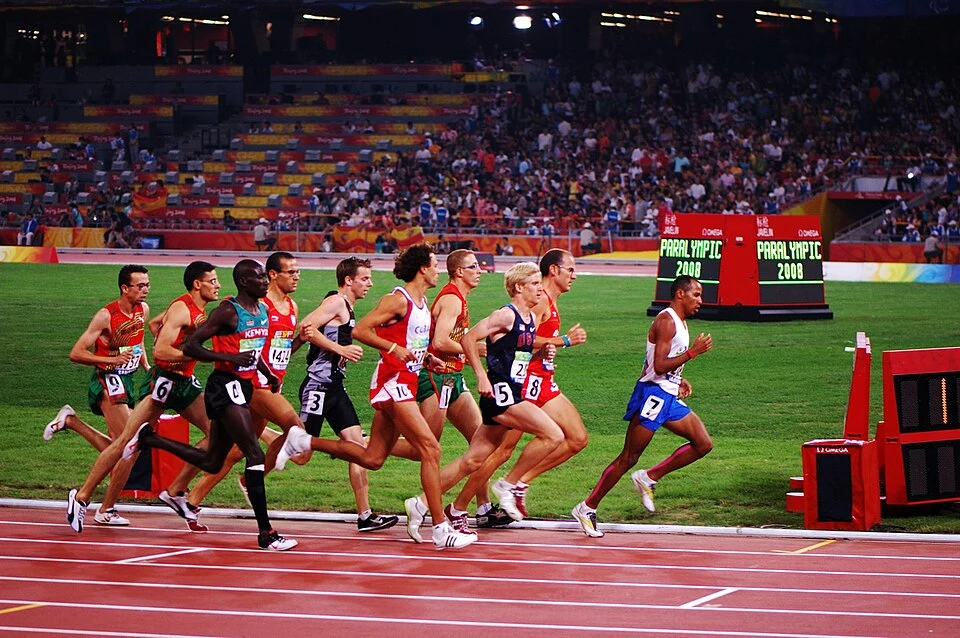
Henry Kirwa competing in the men's 1500m T13 at Beijing 2008.
li yong / CC BY-SA 2.0. Resized for the archive. Image credits.
Henry Kirwa
Paralympic distance-running champion
He built a championship record across several distances.
- Theme
- Champions
Henry Kiprono Kirwa is a Kenyan distance runner whose Paralympic career includes four gold medals and two bronze medals. His results span Beijing, London and Rio, placing him among the country's most accomplished international athletes. His contribution also includes support for people with disabilities and an insistence that their sporting opportunities belong within Kenya's national story.
At the Beijing Paralympics in 2008, Kirwa won three events: the 1,500 metres T13, 5,000 metres T13 and 10,000 metres T12. The range is a substantial part of the achievement. These were different races with different demands, contested within the same Games. The International Paralympic Committee records first place in all three finals.
He continued to compete at the highest level after Beijing. At the 2011 world championships in Christchurch he won silver in the 1,500 metres T12 and 5,000 metres T12. In London in 2012 he took bronze in the 5,000 metres T12. Four years later, at Rio, he won the 5,000 metres T13 and added bronze in the 1,500 metres T13. The sequence gives his career a continuity that cannot be conveyed by mentioning only the Beijing triple.
Kirwa competed in classifications for athletes with visual impairment. Recording the event and classification is important to an accurate sporting history. A result belongs to a particular competition, and it should not be silently merged with a different event because both are described as distance running. His achievements deserve the same precision routinely given to Olympic performances.
An IPC profile published in 2020 also described the life around those results. Kirwa discussed the difficulty of maintaining training when financial circumstances were strained, and his plans to consider marathon running as he grew older. Those statements record his intentions at the time. They should not be presented as proof that every proposed later race or career change occurred.
The same profile documented his community work. After Beijing, he used part of the financial reward associated with his success to support households including people with disabilities. It also described assistance with school fees and the development of the Henry Kiprono Kirwa Foundation. These activities connected public recognition with an effort to widen opportunities for others.
His career therefore has two closely related dimensions. The results establish an athlete capable of winning across successive international championships. The wider work addresses who can enter sport and education, and what recognition can make possible beyond an individual career. Neither dimension needs to be reduced to a general story about overcoming adversity. Both are made concrete by the races, decisions and support described in the record.
Kirwa's place in this archive gives Paralympic achievement its proper weight within Kenyan history. Distance running is part of the country's international identity, but that identity is incomplete when it overlooks athletes competing outside the Olympic programme. His four gold medals, the longevity of his career and his work with others provide a substantial account of sporting excellence and public contribution.
That community support included giving cows to households, intended to provide a continuing resource alongside assistance with education.
Add to this story