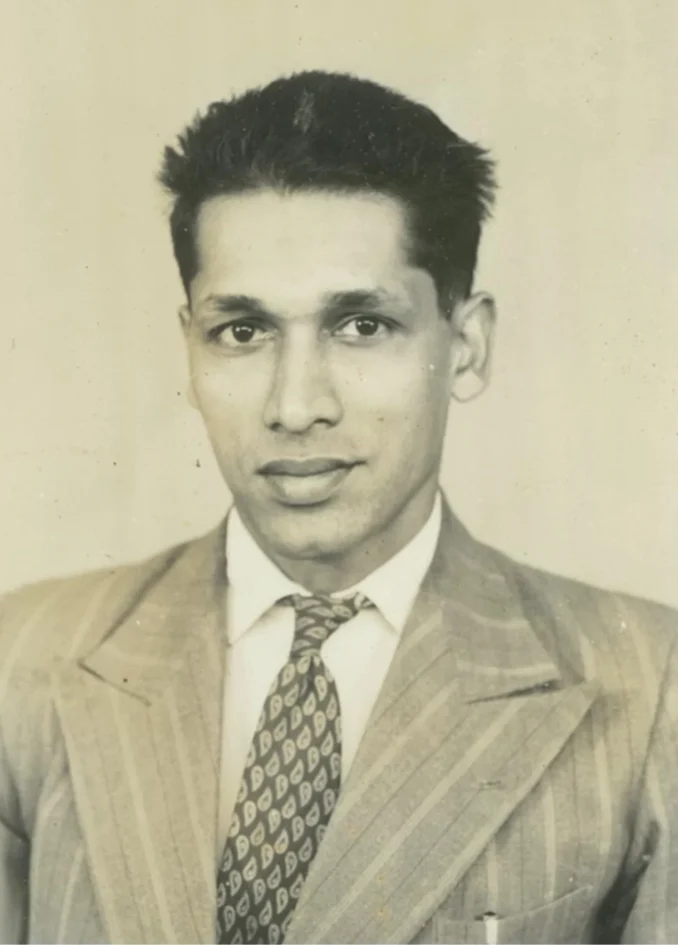
Unknown photographer / Public domain. Resized for the archive. Image credits.

Pio Gama Pinto
Freedom fighter · Journalist
1927 – 1965
He gave the struggle a printing press, and his life.
- Theme
- Liberation
Pio Gama Pinto, born to a Kenyan-Goan family, threw himself into the anti-colonial struggle as an organiser, a journalist and a quartermaster; moving funds, arms and ideas to the Mau Mau and the independence movement, and paying for it with detention. A committed socialist, he believed independence had to mean justice for the poor, not merely a change of rulers. In February 1965 he was gunned down outside his home, the first political assassination of independent Kenya. He is a reminder that the heroes of this nation came from every community within it.
Life and work
Pio Gama Pinto (31 March 1927 – 24 February 1965) was a Kenyan journalist, politician and freedom fighter. He was a socialist leader who was key in Kenya's struggle for independence. He was assassinated in 1965, leading many to consider him independent Kenya's first political martyr.
Pinto was born in Nairobi on 31 March 1927 to a family of Goan Catholic descent. Born to immigrant Goan parents hailing from the Portuguese Goa, his father was an official in the colonial government of Kenya while his mother was a housewife.
At age eight, he was sent to Goa for his education and spent the next nine years there, passing his matriculation exams at St. Joseph's High School, Arpora and then moving to the Bombay Presidency, studying science at Karnatak College, Dharwar for two years before joining the Royal Indian Air Force in 1944 as an apprentice ground engineer. He then took up a job in the Posts and Telegraph office in Bombay, participated in a general strike and became a founding member of the Goa National Congress whose aim was the liberation of Goa from Portuguese rule.
When only seventeen, he started an agitation in Bombay against the Portuguese colonial occupation of Goa. His political activism soon made it necessary for him to return to Kenya to avoid being arrested and deported to the Tarrafal concentration camp in Cape Verde.
In 1949, Pinto returned to Kenya and, after a succession of clerical jobs, became involved in local politics aimed at overthrowing British colonial rule in Kenya. In 1951, he co-founded the East African Indian Congress, a nationalist political party dedicated to building support for independence amongst the South Asian community of Kenya. Pinto also turned to journalism, writing for the Colonial Times, Daily Chronicle and The Uzwod. From 1952, he was also a regular contributor to the international services of All India Radio, where he produced a popular anti-colonial program named Goan Newsletter. He also worked closely with British anti-colonial activists, including the Independent Labour MP Fenner Brockway, to inform the world press of political developments in Kenya. This international activism, however, brought Pinto to the attention of Kenya's colonial authorities. In 1954, five months after his marriage to Emma Dias, he was rounded up in the notorious Operation Anvil and spent the next four years in detention on Manda Island. He was kept in confinement from early 1958 until October 1959 at Kabarnet.
In 1960, he founded the Kenya African National Union (KANU) newspaper Sauti Ya KANU, and later, Pan African Press, of which he subsequently became Director and Secretary.
Pinto also formed Kenya Freedom Party, a multiracial socialist organisation, but dissolved the party when KANU allowed non-Africans to join its ranks for the first time. Pinto subsequently played an active role in campaigning for KANU during the 1961 elections, which the party won comfortably. From 1962, Pinto turned his attention to Mozambique, which was still under Portuguese colonial rule, and worked closely with the anti-colonial group FRELIMO. In 1963 he was elected a Member of the Central Legislative Assembly and in July 1964 was appointed a Specially Elected Member of the House of Representatives. He worked to establish the Lumumba Institute in 1964 to train KANU party officials.
On 24 February 1965, at the Westlands neighbourhood of Parklands in Nairobi, Pinto was shot at close range in the driveway while waiting for the gate to be opened. He was with his daughter in his car at the time of his killing. Pinto became the first Kenyan politician to be assassinated after Independence. At the time of his assassination, Pinto was 38.
This section adapts selected passages from Pio Gama Pinto by Wikipedia contributors. It is shared under CC BY-SA 4.0. Selected passages; pronunciation guides, lists and reference markers omitted; punctuation and paragraph breaks adjusted. Photographs have separate licences.
He insisted freedom must feed people, not just flags.
Add to this storyMore from Liberation
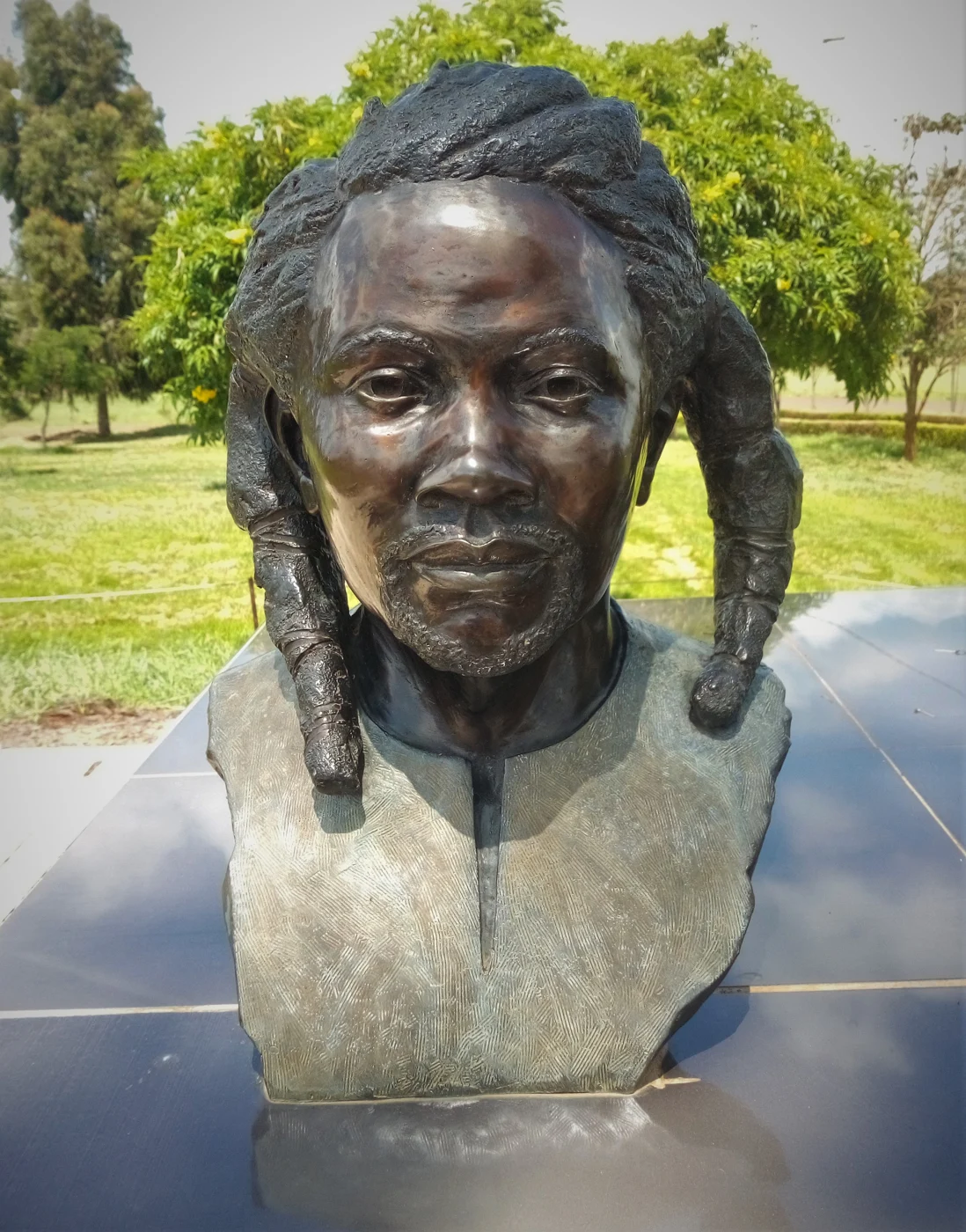
Dedan Kimathi
Field Marshal of the Mau Mau
c. 1920 – 1957 · Memorial bust
Mekatilili wa Menza
Leader of the Giriama resistance
fl. 1910s
A woman who raised a people against the empire with a dance and an oath.
Muthoni Kirima
Mau Mau Field Marshal
1930 – 2023
A woman who became a field marshal in the struggle for independence.