Wambui Otieno
Freedom fighter and women's rights campaigner
She refused the roles that others assigned to her.
- Theme
- Liberation
Wambui Otieno participated in the independence struggle and later became an outspoken campaigner in Kenyan public life. Her autobiography, Mau Mau's Daughter, offered a woman's account of political organising and the personal costs of resistance.
Her widely followed struggle over the burial of her husband, S. M. Otieno, also exposed conflicts between customary authority, marriage and women's agency. Her life connects the history of liberation with unresolved questions about who gets to make decisions within a family.
Life and work
Virginia Edith Wambūi Otieno (1936–2011), born Virginia Edith Wambūi Waiyaki, who became Wambūi Waiyaki Otieno Mbūgua after her second marriage, and generally known as Wambūi was born into a prominent Kikuyu family and became a Kenyan activist, politician and writer. Wambūi became prominent in 1987 because of a controversial legal fight between her and the clan of her Luo husband Silvano Melea Otieno over the right to bury Otieno. The case involved the tension between customary law and common law in modern-day Kenya in the case of an inter-tribal union. The various legal hearings this case stretched over more than five months and the final verdict suggested that a Kenyan African was presumed to adhere to the customs of the tribe they were born into unless they clearly and unequivocally broke all contact with it. As Otieno retained some rather tenuous links with his clan, they were awarded the right to bury him, ignoring Wambui's wishes. However, Wambūi inherited most of her late husband's estate.
Much of the commentary about Wambūi's ancestors and early life comes directly or indirectly from her autobiography, Mau Mau's Daughter: A Life History. However, its account of her ancestor, Waiyaki wa Hinga, has been criticized for attempting to make him a proto-Nationalist and inflating his importance, and her role as a scout and urban guerrilla may have been overstated.
Wambūi was the great-granddaughter of Waiyaki wa Hinga, a Kikuyu leader who was arrested in 1892 by officials of the Imperial British East Africa Company and who died in suspicious circumstances soon after the arrest. Wambūi claimed in her autobiography that he was murdered by being buried alive for opposing the violent seizure of Kikuyu land. However, Waiyaki wa Hinga had initially cooperated with Frederick Lugard of that company in 1890, and his quarrel with Lugard's successor was over the latter's seizure of some of Waiyaki's cattle without payment rather than Waiyaki's opposition to colonial land expropriation.
In Kikuyu oral tradition and folklore, Waiyaki wa Hinga, is represented as a major chief and fighter against the British invaders, but he had an ambiguous record of working with the Imperial British East Africa Company. His death was probably caused by injuries sustained during, and possibly after, his arrest and he was buried on his way to detention, whether already dead or assumed to be dying is unclear. Wambūi disputed the charge that Waiyaki collaborated with the British colonists, by preferring Kikuyu oral traditions to historians' versions that she labelled as Eurocentric, even where the historians are Kenyan, and claimed the family of Waiyaki wa Hinga were the natural leaders of Kenya because of his actions.
Wambūi's grandfather, Mūnyua Waiyaki, donated some land he owned to the local Church of Scotland mission, as a result of which his son, Waiyaki Wantoni, often known as "Tiras" was educated at a Church of Scotland school and, in the 1940s, became Kenya's first African police inspector and later a chief inspector, which Wambūi claimed was compensation for the death of Waiyaki wa Hinga. Tiras Waiyaki became involved in nationalist politics in the 1950s and during the Kenyan Emergency, he was detained in 1954. Wambūi claimed that this impoverished his family and interrupted his children's education, but his detention was only for four months followed by his reinstatement, after which he cooperated with the Kenyan colonial administration. Although Wambūi states he also covertly assisted Mau Mau, this was in minor ways which were outweighed by his pro-colonial actions.
Wambūi was born in Kiambu District in southern Kikuyuland on 21 June 1936 to a well-off family of landowners. Her father, Tiras Waiyaki Wantoni, was a police inspector and she mentioned three elder brothers who had been educated in Britain. One of her brothers was Kenya's former foreign Minister, Dr Munyua Waiyaki. She received a missionary education, including being a boarder at Mambere Girls School, a secondary school with the highest level of education then available for African girls.
This section adapts selected passages from Wambui Otieno by Wikipedia contributors. It is shared under CC BY-SA 4.0. Selected passages; pronunciation guides, lists and reference markers omitted; punctuation and paragraph breaks adjusted. Photographs have separate licences.
More from Liberation
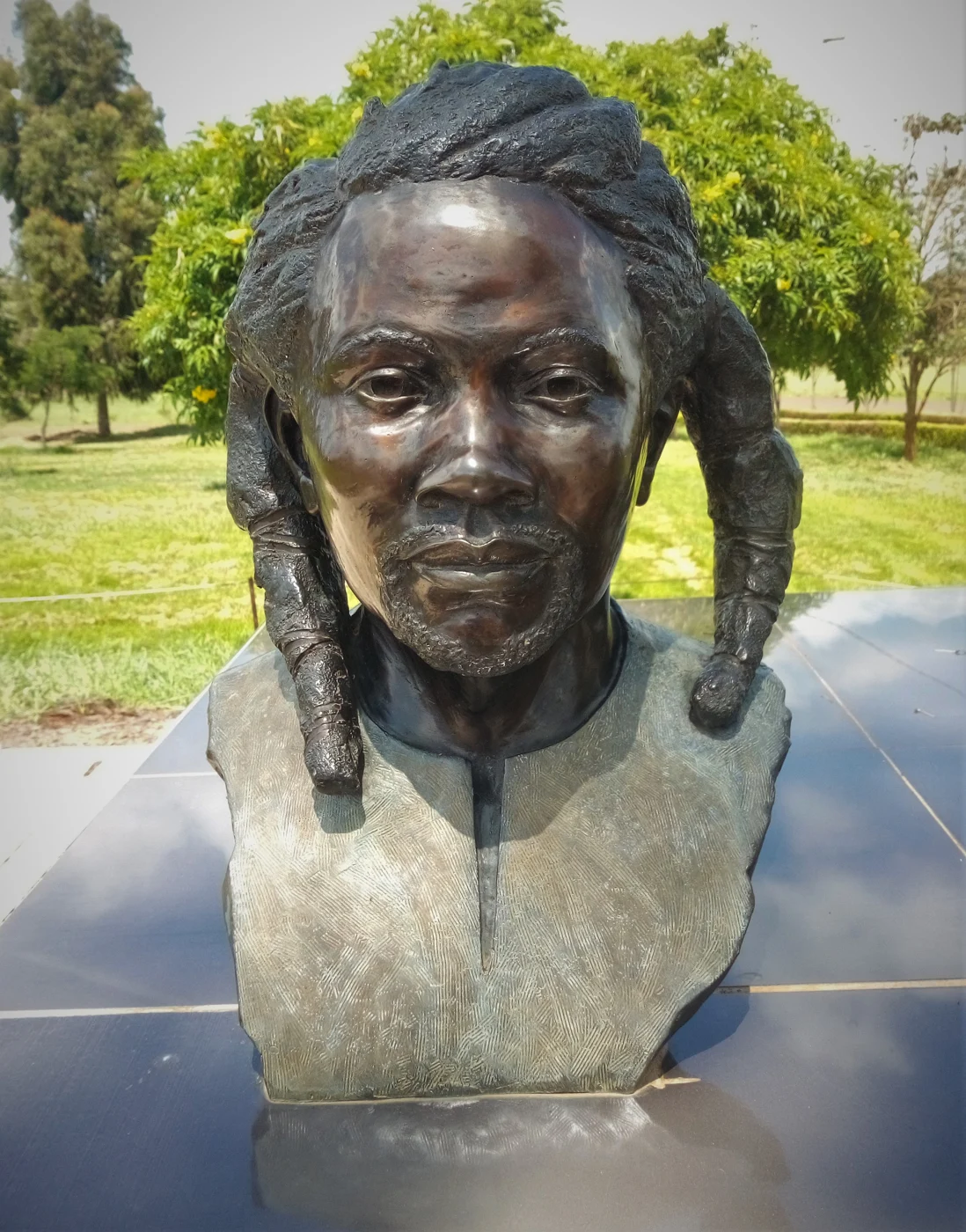
Dedan Kimathi
Field Marshal of the Mau Mau
c. 1920 – 1957 · Memorial bust
Mekatilili wa Menza
Leader of the Giriama resistance
fl. 1910s
A woman who raised a people against the empire with a dance and an oath.
Muthoni Kirima
Mau Mau Field Marshal
1930 – 2023
A woman who became a field marshal in the struggle for independence.