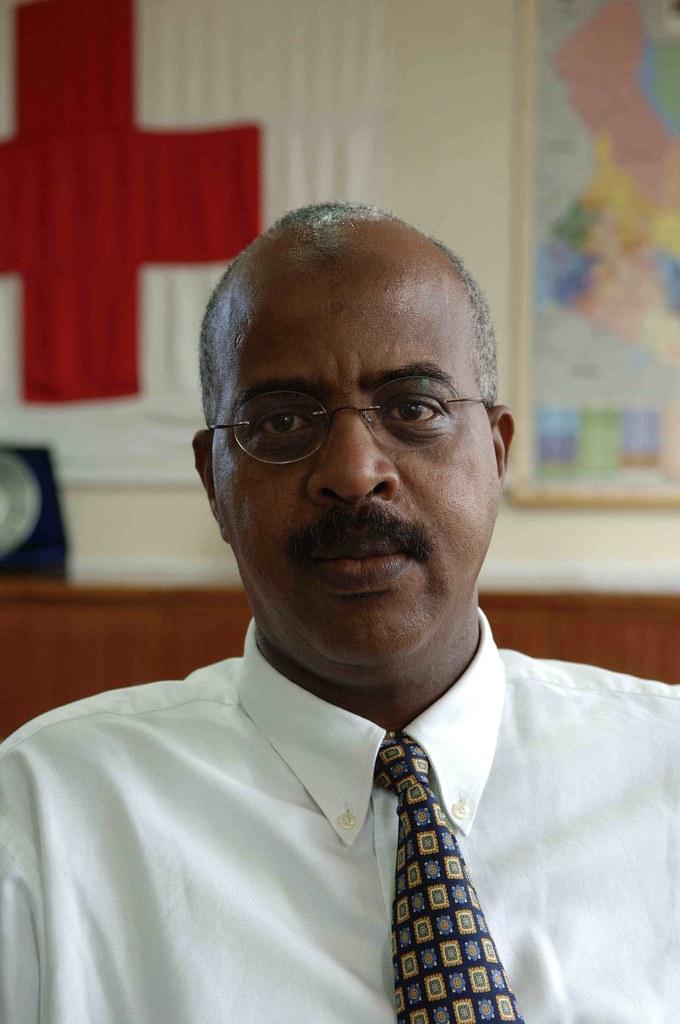
Olav A. Saltbones / Norwegian Red Cross; published by Fingo / CC BY-NC-ND 2.0. Published file, unaltered. Image credits.
Abbas Gullet
Humanitarian organiser
He helped build the capacity to respond when disaster arrived.
- Theme
- Community
Abbas Gullet's humanitarian career began with an interest in first aid and grew into leadership within the Kenya Red Cross and the wider Red Cross and Red Crescent movement. His contribution is associated with emergency response, the development of institutions and the organisation of people who can act when a crisis interrupts ordinary life. That work depends on preparation long before an ambulance or relief team becomes visible to the public.
Born in Garissa and raised in Mombasa, Gullet attended school on the coast. Paukwa's account describes his encounter with first-aid training through the President's Award programme while he was a secondary-school pupil. The course led him towards the Red Cross youth organisation. It connected a practical skill with a wider commitment to service and provided an early route into a movement in which volunteers carry much of the work.
After working for the Kenya Posts and Telecommunications Corporation, he joined the Kenya Red Cross as a national first-aid officer in 1985. His later career included international postings and senior responsibilities within the International Federation of Red Cross and Red Crescent Societies. He also studied management, completing an MBA at Lancaster University. These developments brought operational experience together with the administrative demands of running a humanitarian organisation.
Gullet subsequently led the Kenya Red Cross as secretary general. His work is associated with strengthening the society's capacity to respond to emergencies and mobilise support. A national response system requires transport, supplies, trained staff, volunteers, local relationships and reliable decisions. The person leading it must help maintain those connections between major emergencies as well as during them. Public confidence is part of that capacity, because a humanitarian institution needs people to trust both its purpose and its ability to deliver.
His international service also included a term as the IFRC's vice-president for Africa. In his 2019 nomination statement for the movement's Standing Commission, he described a career extending from youth volunteering to national and international leadership. That first-person record is useful for identifying the roles he held, while the effectiveness of institutions remains a matter that should be assessed through their wider record.
The Council of Europe named him one of the recipients of its 2017 North-South Prize, alongside Finnish Red Cross leader Kristiina Kumpula. The award recognised humanitarian solidarity. It placed a Kenyan practitioner within an international discussion about the responsibilities people and institutions have towards one another across national boundaries.
Gullet's story also makes visible a form of leadership that is usually presented through moments of urgency. Emergency work is often remembered through a rescue, a disaster appeal or an exceptional act of courage. Those moments depend on routine work: a volunteer trained, equipment maintained, information checked, and a local branch ready to respond. His contribution includes the effort to make such preparation part of an institution rather than relying only on improvisation.
Remembering him therefore means remembering the volunteers and colleagues whose collective work gives humanitarian leadership its practical meaning. A single name can offer an entry into that history, but it cannot stand in for everyone who carries it. His career belongs to the development of Kenya's capacity to provide organised assistance when people are most exposed to danger and disruption.
Add to this story