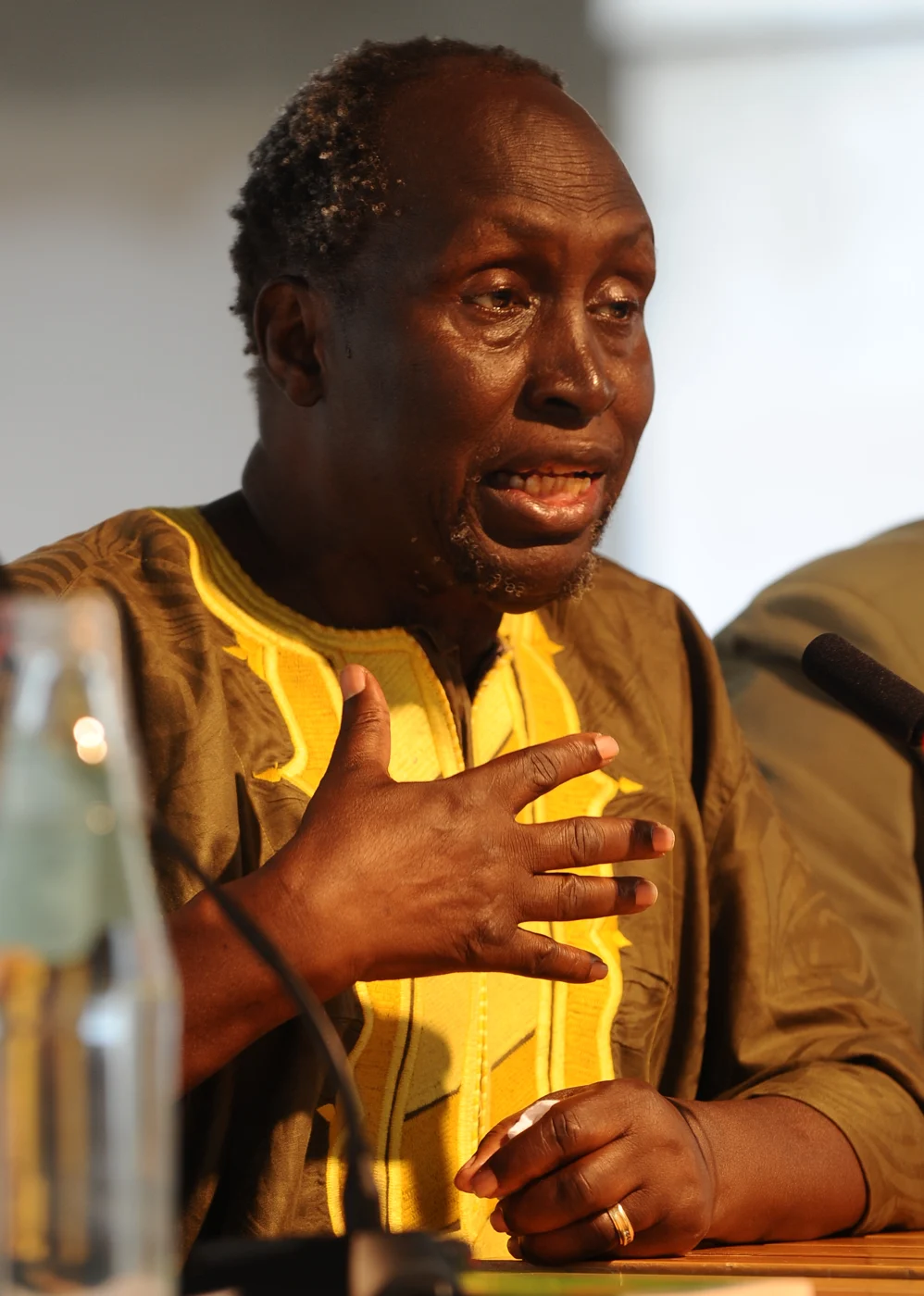
Alamin Mazrui
Linguist and scholar
He examined how language shapes belonging and power.
- Theme
- Arts & Letters
Alamin Mazrui is a Kenyan scholar, teacher and writer whose work examines the relationship between language and public life. His research on Kiswahili connects literature and linguistic study with questions about authority, identity, education and civil liberties. His place in this archive rests on a sustained intellectual contribution: taking African languages seriously as ways through which people create knowledge and participate in society.
He trained across several fields. Rutgers University records degrees in biology and language education, followed by a doctorate in linguistics at Stanford University. His specialisation in the political sociology of language brought the study of linguistic forms into conversation with the institutions and inequalities through which languages acquire power. A language is not used in a vacuum. Its place in a school, courtroom or public office can affect who is able to participate on equal terms.
Mazrui has taught in East Africa, West Africa and the United States. His teaching has included linguistics, literature, Kiswahili studies, Islam, identity and cultural politics. The breadth of those subjects reflects a career in which language is connected with social experience rather than treated as an isolated technical object. Teaching also extends the work beyond an individual scholar's publications, helping students develop the questions and methods through which a field continues.
His books and collaborative writing include Swahili, State and Society: The Political Economy of an African Language, The Power of Babel: Language and Governance in the African Experience, and The Swahili: Idiom and Identity. Their subjects bring East African experience into a wider discussion of governance and cultural belonging. They also offer readers ways to understand why decisions about language can become political questions even when presented as merely practical choices.
Rutgers' research record documents continuing work on translation, censorship, conflict and the spread of Kiswahili. These subjects connect the circulation of words with the circulation of authority. Translation can make an argument available to a new audience, but it can also change the assumptions through which that argument is understood. Examining these processes is part of writing a history of ideas that recognises more than the languages of former colonial powers.
Mazrui's career also includes consultancy on language and the law, language and urbanisation, and work with scholarly organisations. Rutgers identifies contributions to the UNESCO History of Africa Translation Project and other international research initiatives. These collaborations show how scholarship can help build the shared resources on which other teaching and research depend.
Alongside his academic writing, he is a published Kiswahili poet and playwright. That combination matters. The creative work and the research approach language from different directions, but both depend on taking its possibilities seriously. He has helped examine Kiswahili as an object of scholarship while also using it as a medium of literary expression.
His contribution to Kenya's intellectual history therefore includes books, classrooms, creative writing and the work of collaboration. It asks readers to consider whose language counts as a language of thought, and what changes when people can enter public and intellectual life through words that belong to their own experience. Those questions remain part of the unfinished work of cultural freedom.
Add to this story