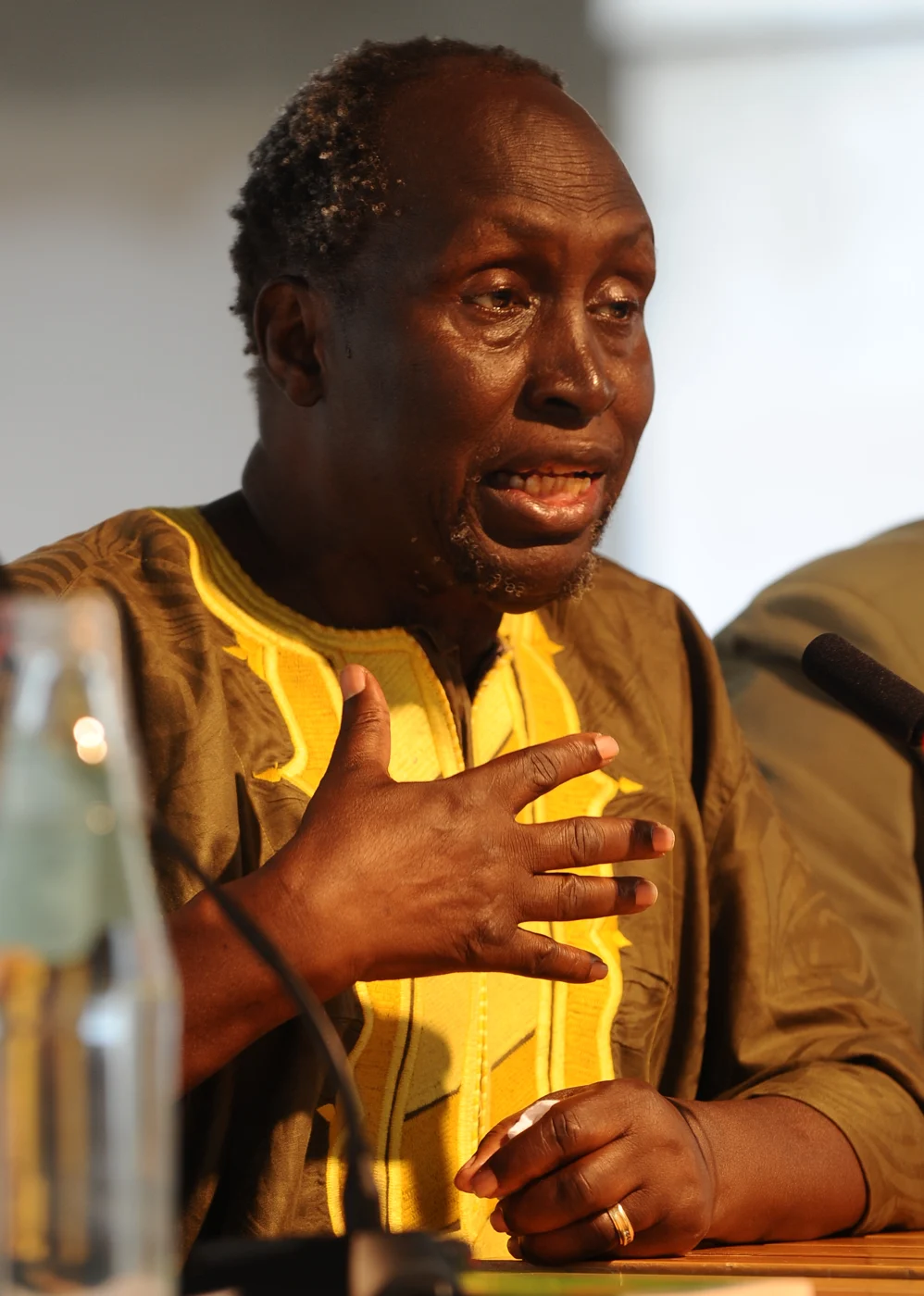
Elkana Ong'esa
Sculptor and arts educator
He helped bring Kisii stone sculpture into international view.
- Theme
- Arts & Letters
Elkana Ong'esa developed a sculptural practice associated with the stone-carving traditions of Kisii. His work has been exhibited and installed in international settings, including diplomatic and public spaces.
As an educator and advocate for the arts, he also helped sustain the conditions in which other artists could work. His contribution links a local material and craft tradition with a broader conversation about contemporary sculpture.
Life and work
Elkana Ong’esa (1944-2024) was a Kenyan soapstone carver. He is considered one of Kenya's most lauded sculptors, and his work is featured outside of buildings across the globe, such as the Coca-Cola headquarters in Atlanta, Georgia, the UNESCO headquarters in Paris, France, and the United Nations Headquarters in New York.
Ong’esa was born in 1944 in Tabaka, a region in Kisii, Kenya famous for soapstone carving. He was introduced to carving as a child when his father created a car for him. That inspired him to start working with various materials like clay and small pieces of stone, and he learned how to use his fingers to work with tools. As a young person, he liked carving birds.
Ong’esa’s uncle, Alexander Mugundy, an artist who made figurines with naturalistic kinds of expressions instead of functional objects like bowls, candlesticks and vases, helped shape Ong’esa’s ideas away from traditional sculpting. Ong'esa began developing a more modern sculpting style and made abstract art and bigger forms.
After receiving an award upon entering an art competition in 1965, his teacher Ms. Janet Green proceeded to assist him to form an art club at his school, where he was appointed chairman. This would also see him drop his ambition of becoming a doctor. After high school, a letter arrived from the ministry of Local Government in Nairobi inviting Ong'esa to study accounting. He was just about to leave for Nairobi when a letter arrived at his secondary school, informing him that he had won a place at Makerere University.
Ong'esa went on to get his bachelor’s degree from Makerere University in Kampala, Uganda where he studied painting and sculpting at Margaret Trowel School of Fine Arts. Margaret Trowell, the pioneer of the Art School, had established a tradition of making field trips to schools in Kenya, spotting talent and scouting possible recruits. That is how Ong'esa was recruited.
In art school, he learned about materials and techniques that weren't part of the traditional culture he’d grown up in. He also learned modeling, printing and how to work with ceramics and glass. After his Fine Arts degree from Makerere, Ong'esa taught Art at Kisii High School. He obtained his Master of Education degree in Teaching of Arts from McGill University in Canada in 1985.
Ong’esa has made numerous stone sculptures using the Kisii soapstone. His gigantic stone creations are displayed across the globe, and his works have been exhibited in numerous venues, such as the United Nations in New York, and numerous art galleries across the world.
Ong’esa’s work is inspired by nature and often features symbols from African myths and songs. His giant granite sculpture gracing the UNESCO headquarters in Paris is known as Enyamuchera (“singing bird” in the Kisii language) and has its origins in the fiscal shrike, a black and white bird native to Sub-Saharan Africa. Another one of his works, inspired by Kenya’s post-election violence, shows scenes of destruction, devastation and despair following the disputed Kenyan elections in late 2007, forever captured in a wooden sculpture.
Ong'esa's 13-tonne granite sculpture, Hands off our Elephants, was to headline the Kenya exhibition at the 2014 Smithsonian Folklife Festival in Washington DC. An interested buyer had even offered Sh1.2 billion (then equivalent to $13.8 million) for the sculpture. Unfortunately, the Kenyan authorities who insisted on handling transport for the 13-tonne elephant, eventually said that it was too heavy to be airlifted.
Onge'sa also worked as an art teacher. He taught overseas for many years and then returned to teach at his hometown of Kisii, where he worked as a Senior Lecturer for Creative Arts at the Kisii Teachers College. He also helped establish his own art school in the Kisii region, so that local artists here would learn how entrepreneurship and be able to support themselves through art.
This section adapts selected passages from Elkana Ong'esa by Wikipedia contributors. It is shared under CC BY-SA 4.0. Selected passages; pronunciation guides, lists and reference markers omitted; punctuation and paragraph breaks adjusted. Photographs have separate licences.