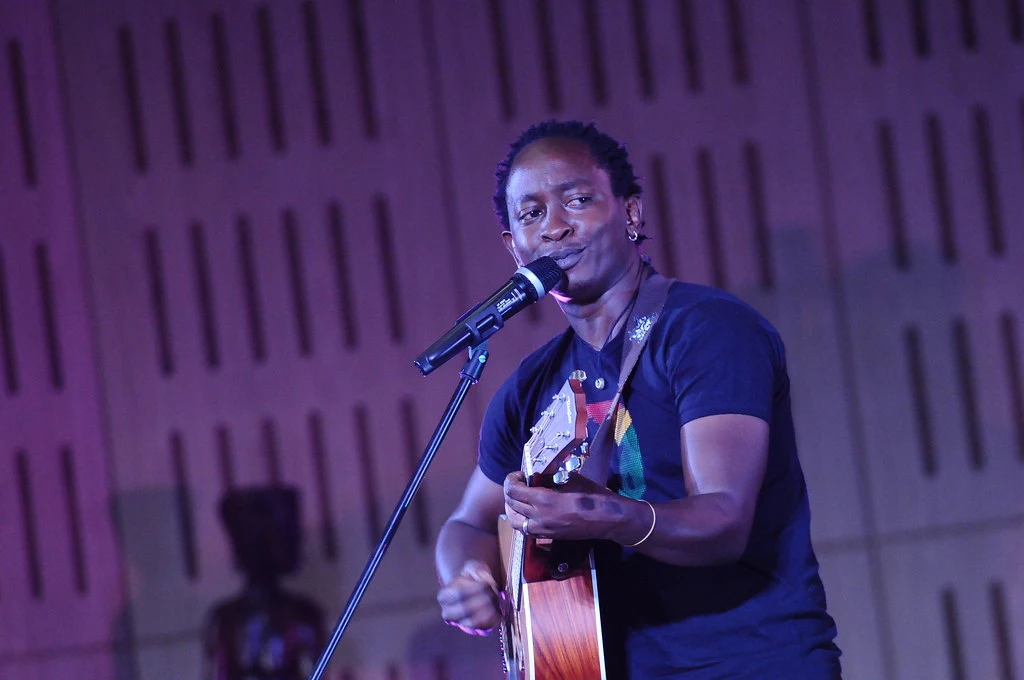
Joshua Wanyama / CC BY 2.0. Resized for the archive. Image credits.
Eric Wainaina
Singer and songwriter
He made a song about corruption part of the national conversation.
- Theme
- Arts & Letters
Eric Wainaina became widely known for music that addressed Kenyan public life, including Nchi ya Kitu Kidogo. His songwriting brought humour, criticism and an accessible musical language to the subject of everyday corruption.
His work also spans performance and musical theatre. It offers an example of popular music acting as a forum where citizens can recognise a shared problem and give it a memorable public voice.
Life and work
Wainaina was born in Nairobi, Kenya, to George Gitaū Wainaina and Margaret Wangarì Wainaina. He has one brother, Simon Wainaina. His love for music started at a young age. He got a piano at age 4, originally intended for his brother Simon who instead took keen interest in football. Wainaina thus begrudgingly took piano lessons. He actively participated in the choir throughout elementary and high school at St. Mary's School, Nairobi, save for a short stint in basketball. Whilst growing up, Wainaina was influenced musically by international artists such as Papa Wemba, Youssou N'Dour, Lokua Kanza and Paul Simon.
Wainaina first stepped into the world of music with Five Alive, a gospel a cappella group. Five Alive consisted of Victor Seii, Bob Kioko, Chris Kamau, and David Mageria, who was replaced by Joe Kiragū. They drew their musical influence from Ladysmith Black Mambazo and Take 6. Dominating Kenya's airwaves in 1995, Five Alive released their debut album Five Alive in 1996, and even went on to tour Europe the same year. His experience with the group convinced Wainaina to pursue a professional career in music. In 1996 he performed and appeared in the video for "Get in the Driver's Seat", a song commissioned by the United Nations Drug Control Programme for a highly successful anti-drug campaign spanning 20 countries. This not only set the stage for his eventual emergence as a solo artist, but also got him into the social concern and activism that characterizes much of his music.
When the group disbanded in 1997, Wainaina went on to join the Berklee College of Music in the US city of Boston, from which he graduated with a degree in music, majoring in songwriting and record engineering. He graduated with honors.
During his years at Berklee, Wainaina and his band traveled around the country to perform, as well as holding regular shows in Boston. Together with his producer, Christian Kaufmann, he worked to produce a sound that would be distinctively Kenyan both in the music and the content of the lyrics. In order to do this, he made sure that he released a new track every time he returned home for vacation, This was well received by his growing fanbase, with his performance at Kenya's Beats of the Season concert in December 2000 being watched live by 15,000 fans and broadcast nationally.
His notable releases include "Daima Kenya", a song that instantly made him Kenya's favorite modern musician. After the 1998 terrorist bombing in Nairobi where over 200 Kenyans died, "Daima Kenya" was adopted as the unofficial song of mourning, receiving extensive radio and TV airplay nationwide. His adaptation of a Kikuyu folk tune "Rìtwa Rìaku" was added to the playlist of every radio station in the nation soon after.
Wainaina returned to the top of Kenya's musical agenda after he released "Nchi ya Kitu Kidogo" (colloquial for bribe) in 2001, a song that launched his crusade against rampant corruption in the country. With the chart success of "Nchi ya Kitu Kidogo", Wainaina received international accolades. Transparency International (Kenya) supported him as an artist who would help educate people on the negativity of corruption, appointing him an ambassador. He was also appointed ambassador for the NGO MS Kenya, Kenya Human Rights Commission and by the Kenya National Commission on Human Rights for his commitment to fighting the abuses to justice through music. This anthem against corruption ("Nchi ya Kitu Kidogo") was not so highly appreciated in all quarters, however, with the government of the day putting up resistance to it by refusing to air it on the national broadcaster, Kenya Broadcasting Corporation. In one instance several attempts were made to keep him from performing at a national event, the Kenya Music Festival, including intimidation and attempts to switch off his microphone.
This section adapts selected passages from Eric Wainaina (musician) by Wikipedia contributors. It is shared under CC BY-SA 4.0. Selected passages; pronunciation guides, lists and reference markers omitted; punctuation and paragraph breaks adjusted. Photographs have separate licences.