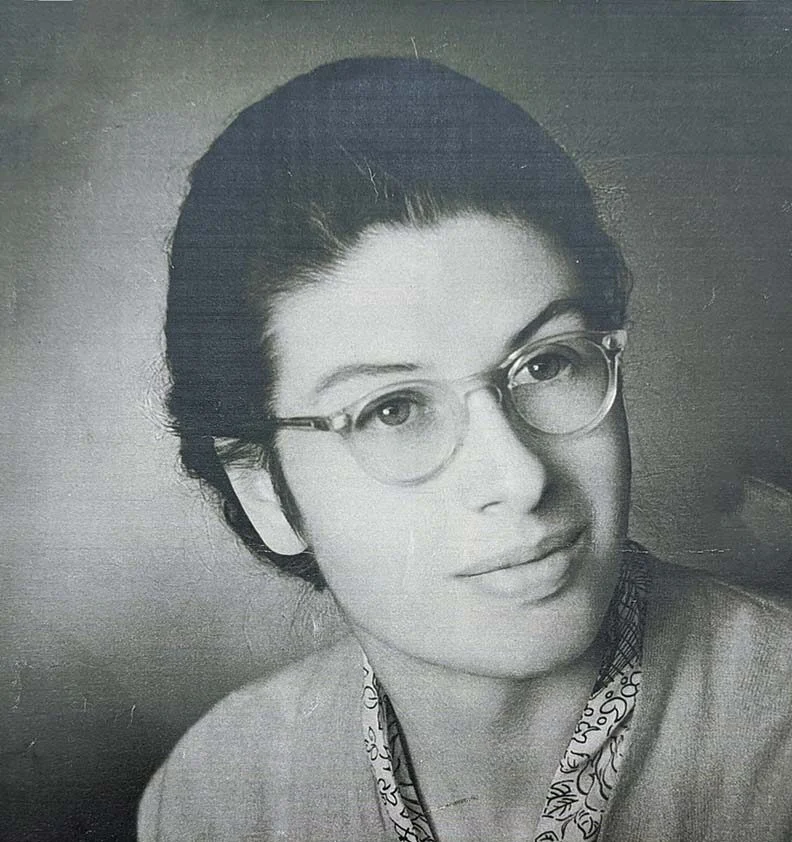
Unknown authorUnknown author / CC BY-SA 4.0. Resized for the archive. Image credits.
Marjorie Oludhe Macgoye
Novelist, poet and bookseller
She followed the lives through which Kenya was changing.
- Theme
- Arts & Letters
Marjorie Oludhe Macgoye made Kenya her home and wrote fiction and poetry attentive to its social transformations. Her novel Coming to Birth follows a woman's life alongside the early decades of the independent nation.
She also worked in Nairobi's book world, helping sustain a community of readers and writers. Her contribution lies in a close attention to ordinary lives and in the literary culture she helped support.
Life and work
Marjorie Phyllis Oludhe Macgoye (21 October 1928 – 1 December 2015) was born in Southampton, England, but immigrated to Kenya soon after Kenya became independent. She was a poet, novelist, and a missionary bookseller. She studied at the University of London for both her bachelor and master's degree. In 1954, she moved to Kenya to sell books and, while there, she met Daniel Oludhe Macgoye, a medical doctor, and they were married in 1960. She became a Kenyan citizen in 1964.
After immigrating to Kenya, she began pursuing a career to become an author. At first, she published stories in magazines; as her success grew, she started writing works of longer length. In early 1970, her novels and poetry were being published. She won awards for many of her books, including for Growing Up at Lina School (1971) and Murder in Majengo (1972), but her most notable novel is Coming to Birth (1986). Her award-winning novels portray the life of a Kenyan woman during the time period 1956–1978.
Marjorie Phyllis King was born on 21 October 1928 in Southampton, England, to Phyllis (née Woolcott) and Richard King. Her father started working as an apprentice at the Vosper Thornycroft shipyard and her mother was a teacher. An only child, Marjorie finished her secondary education in 1945 and studied English at Royal Holloway College, University of London. She worked at Foyles bookshop in London after graduating from college. She received a master's degree in English from Birkbeck College, University of London, eight years later.
Macgoye went to Kenya due to a job application to the Church Missionary Society (CMS), which led to an offer for her to run a CMS bookshop in Nairobi. In 1954, when she arrived in Kenya, the country was going through colonial conflict and was in a tense state. She participated in literacy projects for Africans, and would often give out Christian literature to female prisoners at Remand Prison in Nairobi. There she met Daniel Oludhe Macgoye, the medical officer, and they married in 1960. The couple moved to Alupe Leprosy Mission hospital, near the border separating Kenya and Uganda, and between 1961 and 1966, they had four children together: Phyllis, George, Francis and Lawrence.
In the latter half of the 1960s, Marjorie taught in Kisumu, and began to engage in the Luo community to which her husband and his family belonged, and learning its language, history, traditions and culture, The Luo community even titled her the "mother of Gem". She became a naturalized Kenyan citizen in 1964. In 1971, she and her children moved from Kenya for a job running the university library in Tanzania, while her husband stayed behind. She became the manager of the SJ Moore Bookshop in 1975. She ran literary readings and workshops for many Kenyan and east African writers. From 1983, she switched her focus to writing. During this period, she remained committed to social activism in many ways, such as participating in national debates.
Coming to Birth – Coming to Birth, which won the Sinclair prize, is a novel about the life of a Paulina. In this novel, Macgoye tries to compare the pre-colonial and post-colonial Kenya through the perspective of a Kenyan woman who left her village at the age of 16 to live with her new husband in Nairobi. The novel begins with the introduction of Martin Were, whom Paulina marries. He is educated and belongs to the middle working class. By Kenyan standards, he embodies all the characteristics of a young man with a successful future ahead. However, her husband tries to control her, which leads to an unhappy marriage filled with misunderstanding and disappointment. She suffered three miscarriages and could not fulfill the traditional role of women. Eventually, as Kenya is gaining its independence, she also gains some independence. Every miscarriage she has is a parallel to Kenya's struggle for independence. When she first left home with her husband, Kenya was in a state of emergency. She accepted a job abroad that separated her and her husband. She had to support herself through teaching needlework. She had a child through an affair with another man, but the child was killed, and she returned to Nairobi, where she meets her husband. Paulina was naïve and ignorant when the novel started, but towards its end, she is an independent woman capable of standing up for what she believes in.
This section adapts selected passages from Marjorie Oludhe Macgoye by Wikipedia contributors. It is shared under CC BY-SA 4.0. Selected passages; pronunciation guides, lists and reference markers omitted; punctuation and paragraph breaks adjusted. Photographs have separate licences.