Unknown authorUnknown author / Public domain. Resized for the archive. Image credits.
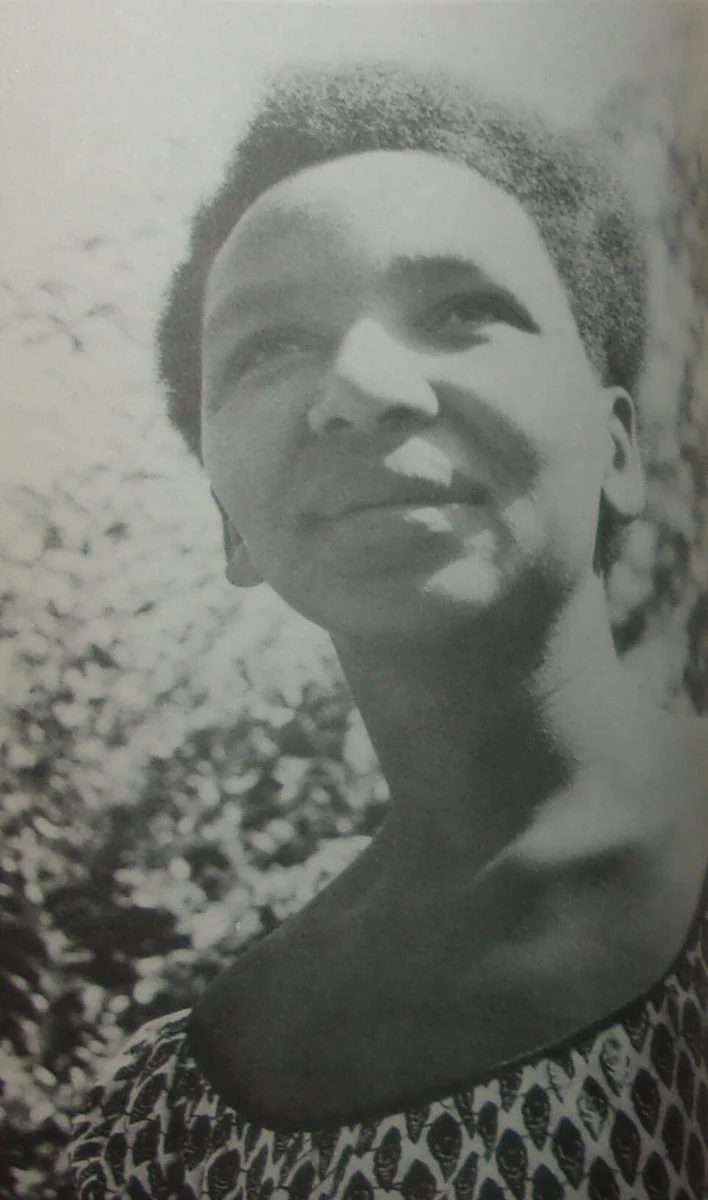
Rebeka Njau
Playwright, novelist and artist
She wrote women into the centre of the drama.
- Theme
- Arts & Letters
Rebeka Njau helped develop Kenyan drama and fiction through works exploring gender, social expectations and the pressures placed on women. Her play The Scar and her novels brought difficult private experiences into public discussion.
Her contribution crosses literature and the arts. It belongs to the history of women who made creative work a way to examine the rules governing their lives, rather than accepting those rules as beyond question.
Life and work
Rebeka Njaū (née Nyanjega; born 15 December 1932) is a Kenya educator and writer, who was Kenya's first female playwright and a pioneer in the representation of African women in literature. Her writing has addressed topics such as female genital mutilation and homosexuality. Her first novel, Ripples in the Pool (1975), appeared as number 203 in the Heinemann African Writers Series.
Rebeka Njaū was born in 1932 in the village of Kanyariri, in Kiambu County to the northwest of Nairobi. Her family was Christian and she recalled the division this created with those around them:It was interesting for us, especially in our home, because we were surrounded by people we would call primitive. They circumcised their girls. In our home my parents were Christians. It's like we lived in two countries because we were separated by traditions. We had nothing to do with one another.Her mother's stance against female genital mutilation bought her into contact with the Mau Mau:She was such a brave woman and Mau Mau wanted to kill her. They changed; I don't know why. They came to kill her but then on second thought, just before they neared our home, they went back.
Njaū was one of only 14 girls admitted to Alliance Girls High School in its inaugural year, before attending Makerere University College in Kampala. While at Makerere, she attended the 1962 African Writers Conference.
She returned to Kenya after graduation to teach at Alliance, before co-founding Nairobi Girls School in 1964. She married Elimo Njaū, an artist from Tanzania. Njaū's teaching career came to an end in 1968, and she and her husband then became increasingly involved with the Paa Ya Paa Gallery in Nairobi, before going on to edit Target, the magazine of the National Council of Churches of Kenya. Njaū separated from husband in 1983, and she published her memoirs, Mirrors of My Life, in 2019.
Her son, Morille Njaū, is an artist and a consultant based in the UK and her daughter Hana Njaū-Okolo is a poet, and published author who lives and works in Atlanta, Georgia. Her nephew was the author Binyavanga Wainaina.
The Scar, a one-act play, is considered the first play written by a Kenyan woman when it appeared in Transition journal in March 1963. It was republished in 1965 by Kibo Art Gallery in Marangu, which was run by Elimo Njaū.
The Scar premiered at the Uganda National Theatre in 1963 and went on to be performed in Kenya, Ghana, Tanzania and the USA. The play centres on the issue of female genital mutilation. The main character is Mariana, a former prostitute who tries to help girls escape female genital mutilation, which she regards as a "brutal custom". She advocates for alternative forms of initiation that can empower girls. Mariana is opposed by other women, who claim to be acting on behalf of the community's elders. The play ends with Mariana being shamed for having an illegitimate child and losing her status.
In 1964, Njaū won a prize in an East African novel competition with her manuscript Alone with the Fig Tree. Following substantial revisions, it was published as Ripples in the Pool by TransAfrica Press in 1975. TransAfrica went bankrupt shortly afterwards, and Njaū contacted Henry Chakava, editor of Heinemann Educational Books East Africa, to see if the novel could be republished. A subedited edition appeared in the African Writers Series in 1978.
The novel tells the story of Selina, a prostitute living in the city who is a modern, independent woman. She decides to marry her younger lover, Gìkere, and they move to his village. Selina miscarries and Gìkere's mother, who already had little respect for her, calls her "an infertile witch". Gìkere responds by trying to assert authority in the relationship by beating Selina. As she becomes more isolated, Selina turns her sexual desires towards Gìkere's younger sister, Gacirū. She experiences a mental breakdown and tries to hang herself, before strangling Gacirū in her sleep. The novel ends with Selina as a "stray woman" wandering the countryside.
This section adapts selected passages from Rebeka Njau by Wikipedia contributors. It is shared under CC BY-SA 4.0. Selected passages; pronunciation guides, lists and reference markers omitted; punctuation and paragraph breaks adjusted. Photographs have separate licences.