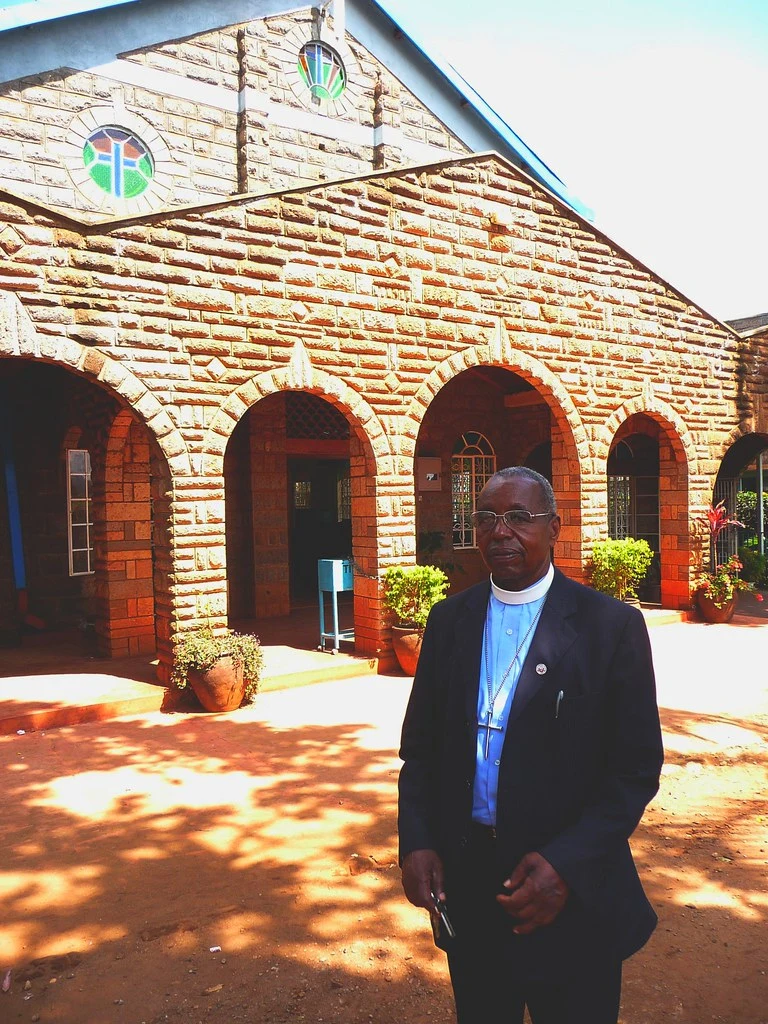
Clément Girardot / CC BY-NC-SA 2.0. Resized for the archive. Image credits.
Timothy Njoya
Theologian and democracy campaigner
He took the demand for freedom from the pulpit to the street.
- Theme
- Conscience
Timothy Njoya publicly challenged authoritarian rule and joined campaigns for democratic reform. His activism made him a prominent voice among clergy involved in the struggle for political freedoms.
He faced violence during confrontations around public protest. His contribution rests on a sustained insistence that ordinary people have the right to participate in decisions about their government.
Life and work
Timothy Njoya (born 7 April 1941 in Nyeri District) is a theologian, human rights activist and a retired Presbyterian Church of East Africa Minister. Njoya holds Master's and Doctor of Philosophy (PhD) degrees from Princeton University. He was ordained as a minister on 20 March 1967 and has served in different parishes including Chuka, Tumutumu, Mathari, St. Andrews, Dagoretti and Kinoo before his retirement in 2011. In 2017 he published his memoirs titled We the People: Thinking Heavenly, Acting Kenyanly.
Rev. Njoya is popularly known for being one of the church leaders who publicly spoke and protested against the autocracy and brutality of the then President Daniel arap Moi in the 1980s and 90s. In his sermons, he advocated for political and social justice reforms in Kenya. In particular, he called for the re-introduction of multiparty democracy and strongly defended the freedom of expression and association as enshrined in the constitution. He was arrested on several occasions as a result of his activism.
Njoya's use of church pulpit as a platform for political activism did not go well with the church leadership that at the time advocated for political neutrality. Njoya condemned the church for remaining silent despite widespread injustices perpetrated by the government. This condemnation saw him subjected to the church disciplinary process before he was transferred from St. Andrews PCEA church in Nairobi to Nyeri in 1987. He nevertheless continued with his activism once he was restored to his position but with more support from the masses that had become more enlightened to the ideas of democracy.
Njoya was one of the leaders of Saba Saba multiparty demonstrations on 7 July 1990 that forced the repressive Moi regime to allow the re-introduction of multi-party state. The demonstrations left eight people dead and many others injured and detained. Njoya was badly beaten by the police.
Njoya's activism also raised a question within his own religious institution: whether political neutrality was possible when people were being denied political rights. His disagreement with church authorities showed that the churches were not a single, uniformly oppositional voice. The public space associated with religious leadership had to be argued over and defended. His memoir, We the People: Thinking Heavenly, Acting Kenyanly, provides a later account of a career in which theology, citizenship and protest repeatedly met. It offers readers a route beyond the familiar image of a cleric confronting police, towards the ideas that informed his actions.
The rights he defended were not confined to people who shared his faith. Freedom of expression and association concern the terms on which everyone can enter public debate. That universal claim gives his religious activism a significance beyond the history of a particular congregation or denomination.
This section adapts selected passages from Timothy Njoya by Wikipedia contributors. It is shared under CC BY-SA 4.0. Selected and edited passages, with additional editorial context; lists and reference markers omitted; punctuation and paragraph breaks adjusted. Photographs have separate licences.