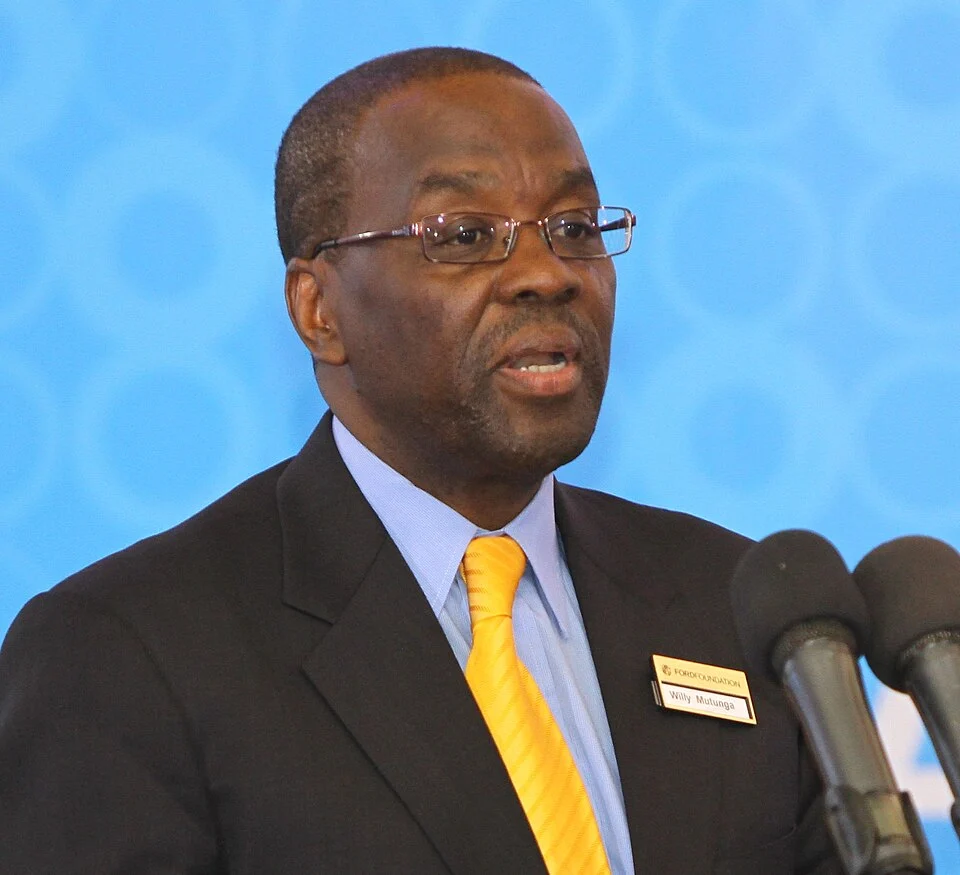
Ford Foundation / CC BY 2.0. Resized for the archive. Image credits.
Willy Mutunga
Lawyer and constitutional reformer
He worked to make the Constitution something people could use.
- Theme
- Conscience
Willy Mutunga's public life spans legal advocacy, civil society and the struggle for constitutional reform. He became Kenya's Chief Justice in 2011, following the adoption of the 2010 Constitution.
His tenure was associated with efforts to transform the judiciary and improve access to justice. His earlier activism also places him within the longer struggle to make state institutions answerable to the people they serve.
Life and work
Willy Munyoki Mutunga, EGH (born 16 June 1946) is a Kenyan lawyer, intellectual, reform activist, and was the Commonwealth Special Envoy to the Maldives. He is also an active member of the Justice Leadership Group. He is the retired Chief Justice of Kenya and President of the Supreme Court of Kenya.
Mutunga's father, Mzee Mutunga Mbiti, worked as a tailor in the small town of Kilonzo, Nzambani in Kitui District. He died in 1985. His mother, Mbesa Mutunga, died in 1982.
Mutunga attended Ithookwe Primary School before proceeding to Kitui School for his Kenya Certificate of Education exams. He was the first student to score six points in the exams (an "A" in all subjects), earning him a place at the Strathmore College for his "A" levels. Mutunga received a Bachelor of Laws degree from the University of Dar Es Salaam in 1971 and a Master of Laws from the University of Dar es Salaam in 1974. Mutunga joined the law faculty at the University of Nairobi as a lecturer, becoming the first indigenous Kenyan to teach constitutional law at the university level. In the late 1980s, he received his Doctorate of Laws from the Osgoode Hall Law School at York University in Toronto.
On 13 May 2011, the Judicial Service Commission of Kenya recommended to President Mwai Kibaki that he appoint Mutunga as chief justice of Kenya. After consulting with Prime Minister Raila Odinga, Kibaki made the appointment, and the National Assembly approved it on 15 June 2011. He was sworn into office on 20 June 2011. Because of Kenya's mandatory retirement age of 70, Mutunga was to leave office on a date not later than 16 June 2017.
Mutunga has been married twice. He has a son and a daughter from his first marriage. He had two other sons with different women in 1993 and 1999.
On 20 July 2000, he married professor Beverle Michele Lax in San Mateo, California. He filed for a divorce on 13 May 2010.
More than two decades of writings, particularly in the media, reveal that Mutunga's activism was inspired by several nationalists. Among these were the anti-colonial fighter Dedan Kimathi, Kenyan activist Pio Gama Pinto, and Guinea Bissau's celebrated nationalist intellectual Amílcar Cabral.
As a law lecturer at the University of Nairobi in the 1970s and 1980s, Mutunga's activism was associated with a small but determined group of academics who identified with Marxist / Socialist ideologies, including Ngũgĩ wa Thiong'o, Al-Amin Mazrui, Kamonji Wachira, and Maina wa Kinyatti. On 19 April 1972, this group formed the University Staff Union (USU). Mutunga became the general secretary of USU in 1979, months after Daniel arap Moi succeeded Jomo Kenyatta as president and began tightening his grip on power. Mutunga immediately rallied other USU officials around a campaign for the reinstatement of Prof. Ngũgĩ wa Thiong'o to his former job of teaching English and Literature at the University of Nairobi. Ngũgĩ was incarcerated by the Kenyatta government in December 1977, and although he was released in December 1978, he never returned to his job. Police arrested Mutunga on 10 June 1980, and USU was banned on 19 July 1980.
Mutunga's arrest threw light on the activities of a seemingly burgeoning Kenyan underground in the repressive 1980s. He was accused of being a member of the underground group known as the December Twelve Movement and of participating in the production of the movement's publication, Pambana. The police alleged they had found stamps used for mailing Pambana after searching Mutunga's house. On 12 June 1982, he was charged in court of being in possession of a "seditious" leaflet bearing the headings "J. M. Solidarity Day" and "Don't Be Fooled: Reject these Nyayos". On 29 July 1982, he was detained, just three days before 1 August 1982 abortive coup by the Air Force. He was also dismissed from his University of Nairobi job.
This section adapts selected passages from Willy Mutunga by Wikipedia contributors. It is shared under CC BY-SA 4.0. Selected passages; pronunciation guides, lists and reference markers omitted; punctuation and paragraph breaks adjusted. Photographs have separate licences.